

The Hidden Project Plan Behind Every Successful Career Relocation
Did you ever say you were going “home” when you were really returning to an Airbnb or hotel? Then you may have chosen a career as a project manager. If so, you know that career relocations may start out as short-term events and then turn into life-changing moves. It did for me.
When I was asked to go to France for a two-week project quality assessment. Little did I know I would turn into a digital nomad. Moving to 3 countries in 3 years. The moves were a culture shock, but so was learning to find a network of colleagues and friends and to understand how to assimilate into my new found home.

Moving For Your Job?
Plan it like a project!
While career relocations may be planned or a surprise, as project managers, we know they should be treated as projects. After all, project management is more than a work skill; it is a life skill. And using these skills to help navigate the big changes in life can make your next relocation work better for you.
Most people treat a career relocation as two separate events: the move, and then the job situation. People who navigate it well treat it as a single integrated project with phases, dependencies, milestones, and risk factors. It's the same framework they would apply to any complex initiative at work. The hidden plan behind every successful career relocation isn't a secret. It's just that most people don't think to apply project thinking to their personal lives until they're already in the middle of a crisis that better planning would have prevented.
Start with the Right “Moving Mindset”
To appreciate why a project mindset is essential, it's helpful to first understand how career relocations fundamentally differ from ordinary moves.
A career relocation has two simultaneous critical paths running in parallel: the organizational path (housing, transport, timelines) and the professional path (job search, network building, employer relationships). Either one can derail the other, and both have hard deadlines that don't flex based on how overwhelmed you are.
Successful people know where to put their focus. This optimizes the energy they expend on small decisions (we all know about the wardrobe choices that Steve Jobs and Mark Zuckerberg famously made to keep everyday decisions simple).
Big decisions work the same. Housing searches, administrative tasks, and the overall chaos of moving consume mental bandwidth that would normally go toward career focus. Professionals who plan for this drain arrive at their destination with momentum rather than exhaustion.
The networking path is where most people underestimate the timeline. Building credibility in a new market takes longer than expected. Productivity rarely survives a move without deliberate effort. Knowing how to be more productive during the transition period is a skill that needs to be actively applied, not assumed.
How to Plan Your Career Relocation
Smooth relocations start with an active plan built around pre-move groundwork, transition continuity, early positioning, and 90-day integration.
Pre-move groundwork means starting the professional work three to six months out: researching the destination market, making initial connections, and, if possible, securing a role or serious conversations before you arrive. Many choose to work remotely temporarily during the transition period. So knowing how to stay productive while relocating can mean the difference between arriving professionally intact and arriving behind.
The Project Management Toolkit for Career Relocation
Many professionals approach relocation as a series of disconnected tasks. Project managers know better. A successful move can be planned and managed using the same tools that deliver successful projects. The framework below shows how common project management concepts can be applied to a career relocation.
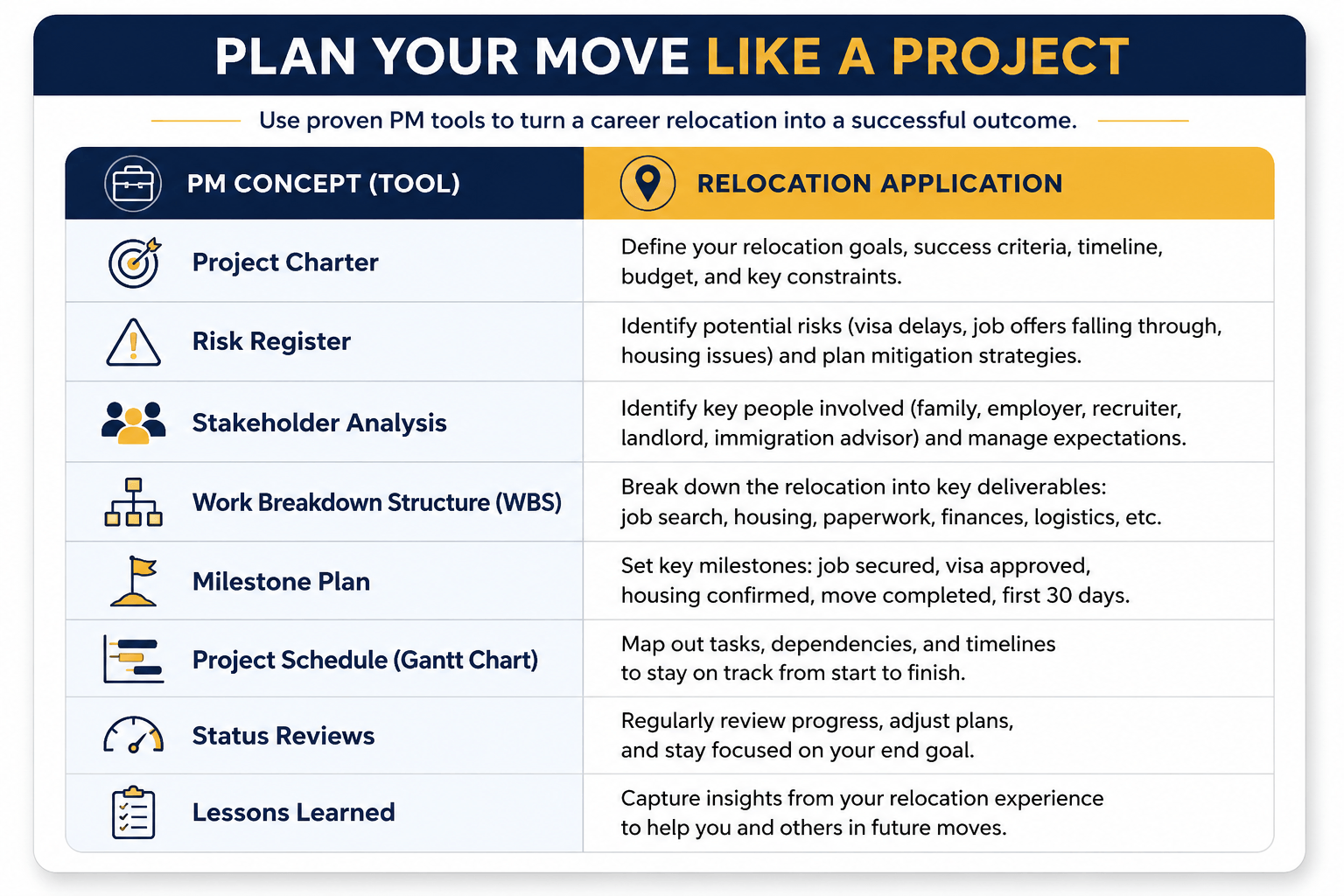
The most important lesson is that relocation is not a single event. It is a project with objectives, stakeholders, risks, dependencies, milestones, and success criteria. You can download this checklist example for more details. For example:
A Project Charter clarifies why you are relocating and what success looks like.
A Risk Register helps you prepare for issues such as visa delays, housing shortages, or changes in employment plans.
A Stakeholder Analysis identifies the people who will influence the outcome, including family members, employers, recruiters, and local contacts.
A Milestone Plan allows you to track progress and maintain momentum throughout the transition.
Using these tools creates structure, reduces uncertainty, and significantly improves the likelihood of a successful relocation. And if you are not familiar with all of the above concepts, check out my Project Manager’s Toolkit, which you can download for free.
Network in Your New Location
Once the groundwork is laid, the next step is to take deliberate action to establish yourself in the new professional environment.
Establishing yourself in a new city requires treating network building as a structured project task, not an organic process that will happen on its own. It won't. At least not fast enough to match the timeline most career relocations demand.

When I relocated to France, I quickly discovered that having a job did not automatically provide a professional network. Building relationships outside my immediate work environment became one of the most important factors in feeling established and creating future opportunities. And just making me feel more at home.
The most effective approach unites online pre-arrival outreach with in-person presence upon arrival. LinkedIn connections in the destination city, informational conversations with local professionals in your field, and identification of key industry events all belong in the pre-move phase. Once you arrive, building a local network quickly becomes the primary professional task in the first 30 days, because local visibility is the one thing remote research cannot duplicate.
Build Long-term Strategies for Success
After you've navigated the initial arrival and begun building your local network, it's crucial to turn your attention to the longer-term strategies that sustain success.
The long-term strategy behind a career relocation is more than simply finding a new job. It involves identifying how your move aligns with your overall career goals and future aspirations. Evaluate what you want from your professional life, such as entering a market with better growth prospects, gaining access to a higher concentration of your industry, or targeting a role that offers new opportunities. Proactive relocations are guided by these objectives, ensuring every step supports your desired direction.
Evaluate relocations by long-term growth, not immediate needs. Pick markets and roles with future value, and align the city to your upward path.
How to Overcome Obstacles to Your Success
Even with preparation, obstacles are inevitable. Being aware of common failure points is essential for effective risk management.
Failed career relocations break down at predictable points.
The first key issue is timeline compression: professional establishment often takes longer than expected, and financial runway can run out before income stabilizes.
The second is social isolation: underestimating the impact of lost informal connections on professional performance. Rebuilding takes time.
According to research published in the Harvard Business Review, professional networks decay significantly during periods of disruption and require active maintenance. A reality that career relocations intensify because the existing network becomes geographically less useful at exactly the moment when professional momentum matters most. Building a replacement network in parallel, not sequentially, is the distinguishing habit of relocations that land well.
When I relocated to the Netherlands, it was for a project assignment, so I immediately had connections through my team. However, I still lacked local knowledge. Although my company managed the visa process, I had to navigate the immigration office on my own. A little research beforehand would have reduced much of the uncertainty and stress. It was a reminder that even when an employer handles the logistics, you remain responsible for your own transition.
Build the Plan Before You Need It
If you are planning a relocation in the next 6 to 12 months, start preparing now. Don't wait until the move is imminent. Define your objectives, identify key milestones, assess the risks, and begin building the relationships that will support your transition.
I was fortunate that my employers initiated my relocations and handled much of the administrative process. That support removed a great deal of complexity, but it couldn't solve the challenges that matter most. I still had to build a network, find a place to live, adapt to a new culture, and create a sense of belonging in an unfamiliar environment. Those experiences required time, effort, and persistence—and they couldn't be delegated to anyone else.
Those moves taught me that successful career relocation is about far more than logistics. It's about intentionally creating the future you want in a new place.
That's why I believe career relocation deserves the same level of planning as any major project. The more preparation you do before the move, the better equipped you'll be to handle the unexpected and take advantage of new opportunities when they arise.
Treat your relocation as a project. Define what success looks like, plan for the risks, invest in relationships, and prepare for the transition ahead. The effort you put into planning today can shape your career for years to come.