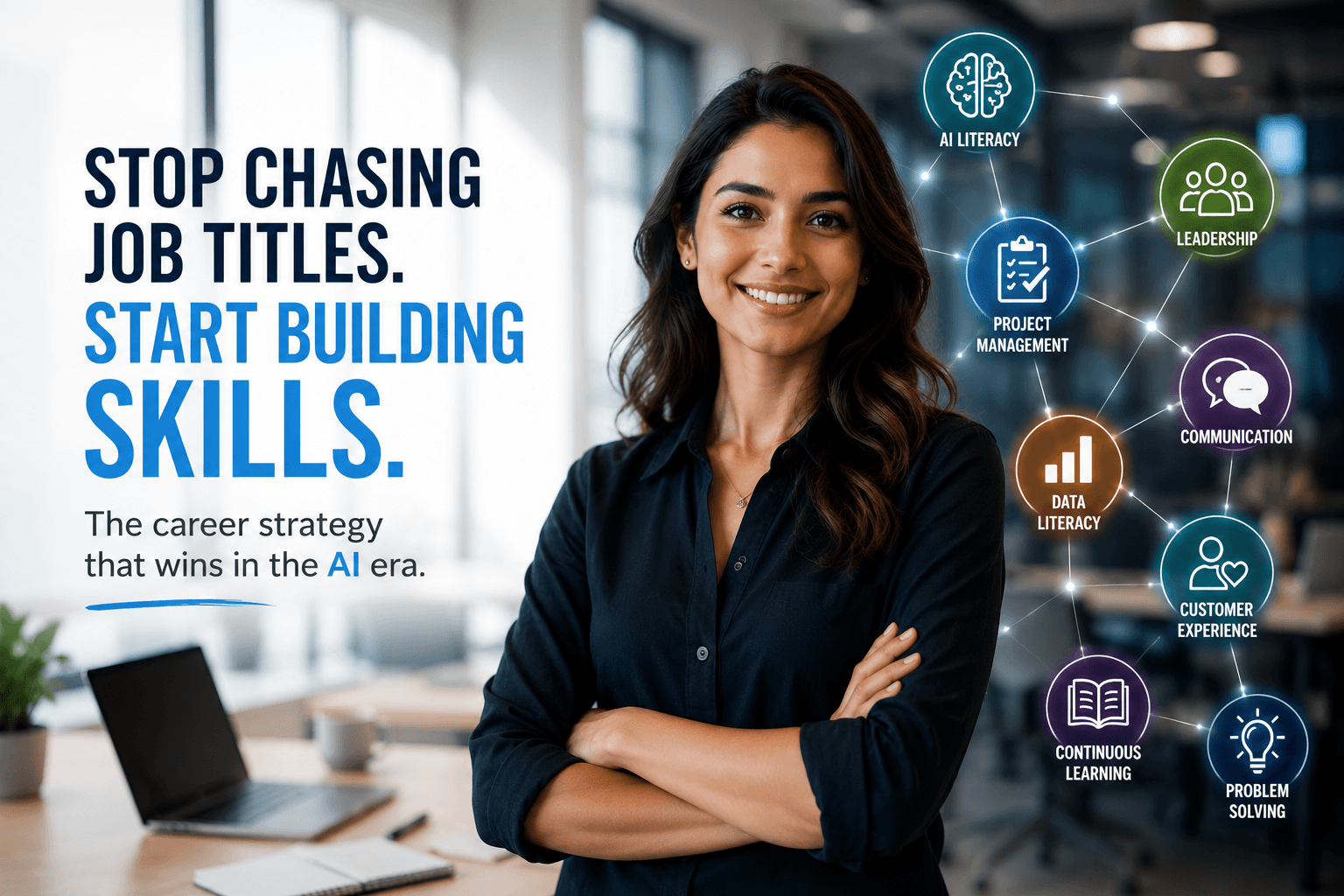
Stop Chasing Job Titles. Start Building Skills.
Why the Future Belongs to People Who Keep Learning
"Skills, not jobs, are changing the world." — Workday.com
That quote stopped me in my tracks.
Not because it was revolutionary, but because it confirmed something I've believed. For myself, and those I mentor. It also reminded me of one of my very first professional conversations.
I had just started my career in Silicon Valley and was chatting with a senior marketing executive. Wanting to sound business savvy, I asked her about her career aspirations.
Without missing a beat, she smiled and said, “I like short titles... like President and CEO."
I remember thinking, That sounds pretty good. Back then I didn't know much about business, but I knew those titles carried weight. Who wouldn't want President or CEO on their business card? Forty years later, I still smile when I think about that conversation. Because here's what I've learned.
Job titles describe where you sit. Skills determine how far you can go.
My Career Didn't Go Exactly the Way I Expected
Like many people, I spent years climbing the corporate ladder in Silicon Valley
Clerk. They took a bet on a person with no obvious skills or no experience.
Supervisor. I showed a willingness to learn and worked hard. They showed me they trusted me.
Manager. I learned how to lead by both good and bad examples.
Director. After I knew where I was headed, I made a plan to get there.
Executive Partner. My passion for the work and client satisfaction paved the way to a role in the management team.
Every promotion came with a longer title and an even longer explanation of what I was responsible for.
On paper, everything looked exactly as it should. But reality hit differently. As I interacted with people at the highest and lowest levels of Fortune 500 organizations. I found new insights: the people who impressed me the most weren't always the ones with the biggest titles.
Sometimes it was the project coordinator who quietly solved problems before anyone noticed them.
Sometimes it was the administrative assistant who knew how everything actually worked.
Sometimes it was the young analyst who asked the one question that changed an entire project.
And yes, another insight was that sometimes I found executives who couldn't execute.
Those insights about people, titles, and outcomes have stayed with me. And taught me something.
Titles don't correlate to results. Skills do.
Welcome to the Skills Economy
For years we built careers around job titles. Today we're building careers around capabilities.
Artificial Intelligence is accelerating that change. Companies aren't simply asking,
"What position have you held?" They're asking, "What problems can you solve?" Or better yet, "What outcomes can you drive?”
These are much better questions today. Because they are more relevant to what businesses need. If AI can write a report, summarize a meeting, build a presentation, or analyze thousands of rows of data in seconds, then our value shifts. Our value comes from thinking. But more than that, businesses are looking for those who are capable of doing things AI still can’t do (and maybe never will):
Leading. Learning how to inspire others to work toward a common goal.
Connecting ideas and people. The communication skill of sharing a vision and creating a team.
Solving problems. The hard task of understanding what is standing in your way and removing it.
Building relationships. Long-term commitment to integrity, trust, and follow-up.
Making decisions. Deciding a course of action, even under pressure, even when there are risks, or the full impact cannot be known.
Those are skills. And unlike a job title, nobody can take those away.
The Skills That Will Drive Your Future
The good news? You don't have to master everything. You just need to keep building skills that organizations value.
When I look across nearly four decades of my career in consulting, leadership, and project work, these are the skills that consistently create opportunities. I find that the fundamental skills are reusable.
Project Management isn't just for project managers. These are organizational capabilities that help you execute effectively and efficiently.
Leadership isn't just for managers. Natural leadership is called many things (like influencer, subject matter expert, or knowledgeable resource), but it’s a person people look to and listen to.
Connection isn't just for presenters. If you can tell a story or sell an idea, you are connecting people and ideas.
AI Literacy isn't just for technical people. These days it is the basic skill set everyone needs to leverage.
These skills are reusable and valuable whether you're a graduate starting your first job or an executive leading a global organization.
Build a Skill Stack, Not Just a Resume
One of the biggest career mistakes I see is people becoming incredibly good at one thing...
...and stopping there.
Today's careers reward people who combine skills.
Think about it.
A project manager who understands AI.
A marketer who understands data.
An engineer who communicates well.
A finance professional who knows customer experience.
A leader who understands change management.
Those combinations are incredibly valuable.
I like to think of it as building a skill stack.
Each new skill makes the others stronger. And developing skills that naturally stack is the best way to develop from the deep skills leaders rely on.
That is why I am a lifelong learner. I intentionally look for new topics to learn. Find an area of personal interest, or ask your company what skills you need, and then go get them. I have built skills which map to exactly that:
Project Management - To implement an early ERP system at my Silicon Valley company.
Mentoring - A skill I developed intentionally by helping others succeed in their careers at IBM.
Leadership - Leading the Human Capital Group at IBM Netherlands.
Customer Experience - From my years working with Apple to designing apps fit for business.
Digital Transformation - Doing strategic work for companies like Shell, AAB, and Ericsson.
To master these skills, I have used a combination of reading, on-the-job training, and courses to earn certifications in AI, Digital Marketing, Six Sigma, Scrum, and now an Executive MBA. What drives me? Learning that supports my work and areas of interest. Building skills that matter to the NGOs and audiences I try to reach today. Not because I wanted more letters after my name. Because every new skill gave me another way to help others solve problems.
Looking back, none of those skills replaced the previous one. They built on each other. That's how careers grow.
Where Should You Invest Your Time?
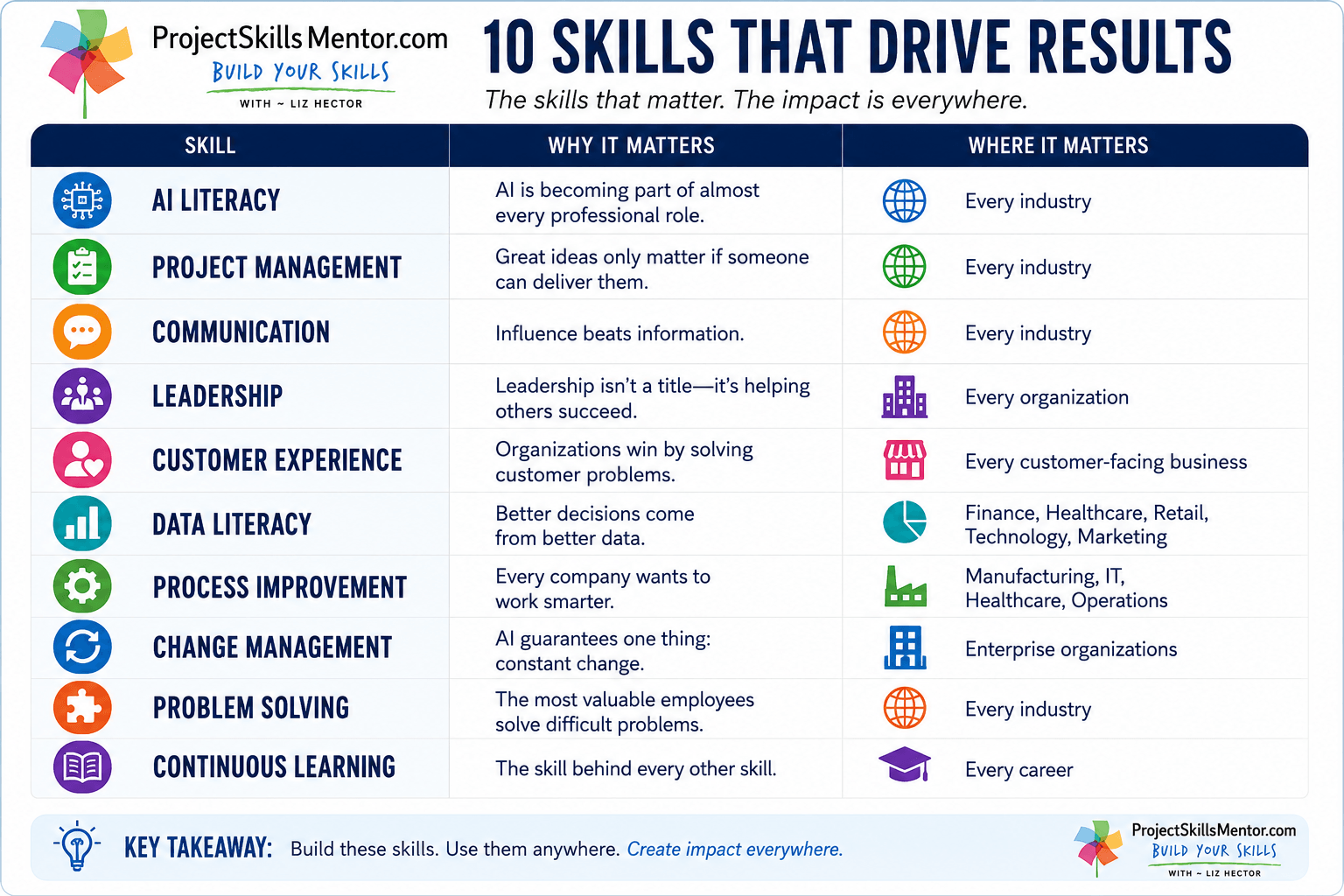
Not every skill has the same impact. Some are useful. Some are career-changing. That's why I created this summary guide.
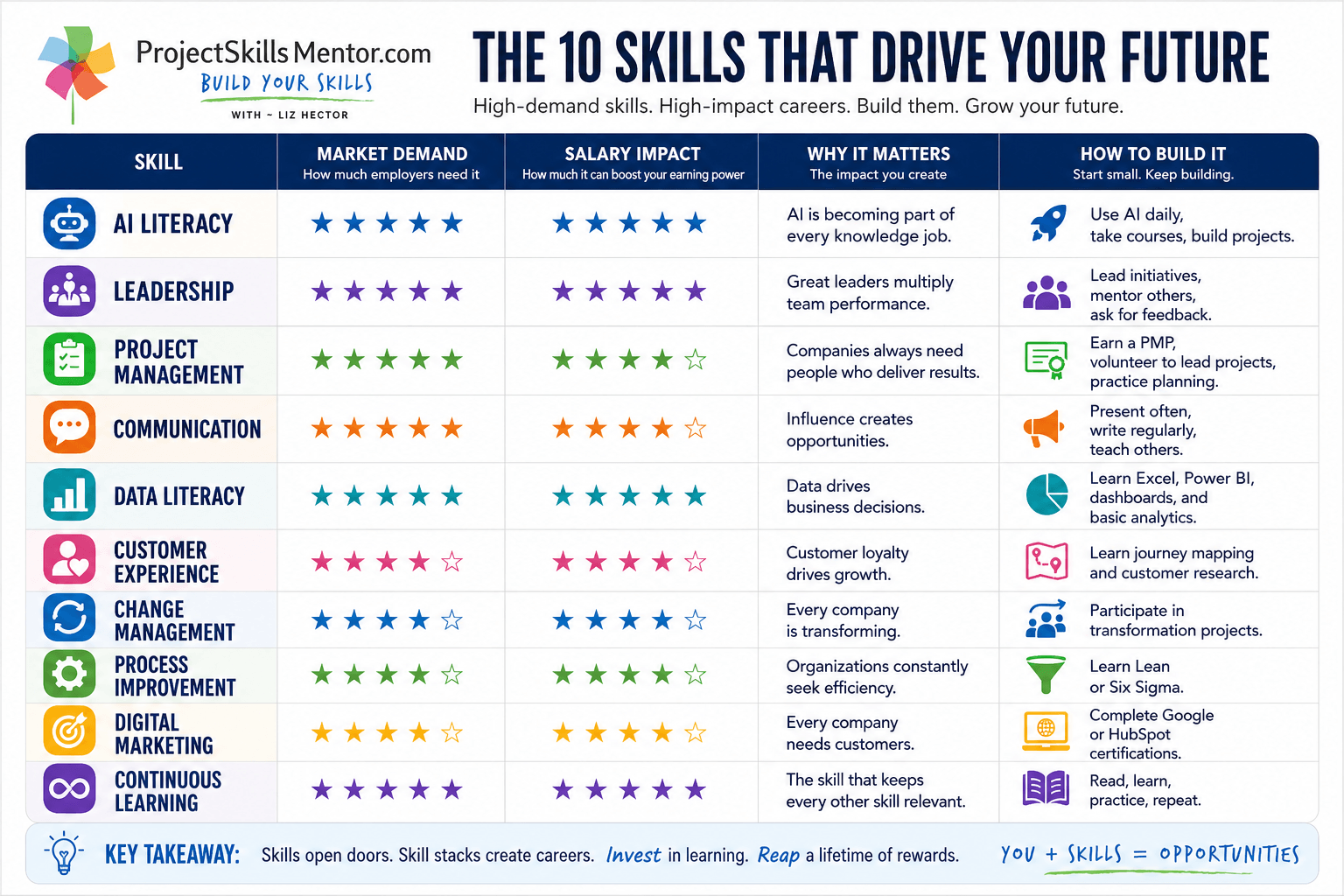
Notice that many of these skills apply almost everywhere. Whether you work in healthcare, banking, retail, manufacturing, technology, government, or your own business, these skills travel with you.
They're portable. And that's becoming one of the biggest career advantages you can have.
Learning Is the New Job Security
My mantra for years has been, "Attitude is everything." Skills change. Technology changes. Industries change. But if you have a learning attitude, you'll keep adapting because you understand that knowledge isn't static; it evolves. The people who continue to grow are the ones who never stop learning.
With this reputation, people often ask me whether they should earn another degree or pursue a certification.
My answer is usually, "What skill are you trying to build?". The credential isn't the goal.
The capability is.
Sometimes that's an MBA.
Sometimes it's a PMP.
Sometimes it's Scrum.
Sometimes it's a Google certification.
Sometimes it's simply reading a great book and applying what you learned on your next project.
The best professionals I've worked with never stopped learning. Neither have I. Even after forty years, I'm still studying: taking courses, earning certifications, interviewing successful people
Because learning compounds. And every new skill opens another door.
Skills Don't Grow by Accident
Here's something I've noticed after mentoring professionals for years.
Everyone wants new skills. Very few people have a plan to build them. The good news?
You don't need to quit your job or spend two years back at university. Most career-changing skills are built a little at a time through experience, coaching, mentoring, and continuous learning. Think of it as building your professional toolbox. Every project, every conversation, every certification, and every mentor adds another tool you'll use for the rest of your career.
Here's the framework I've used throughout my own career.
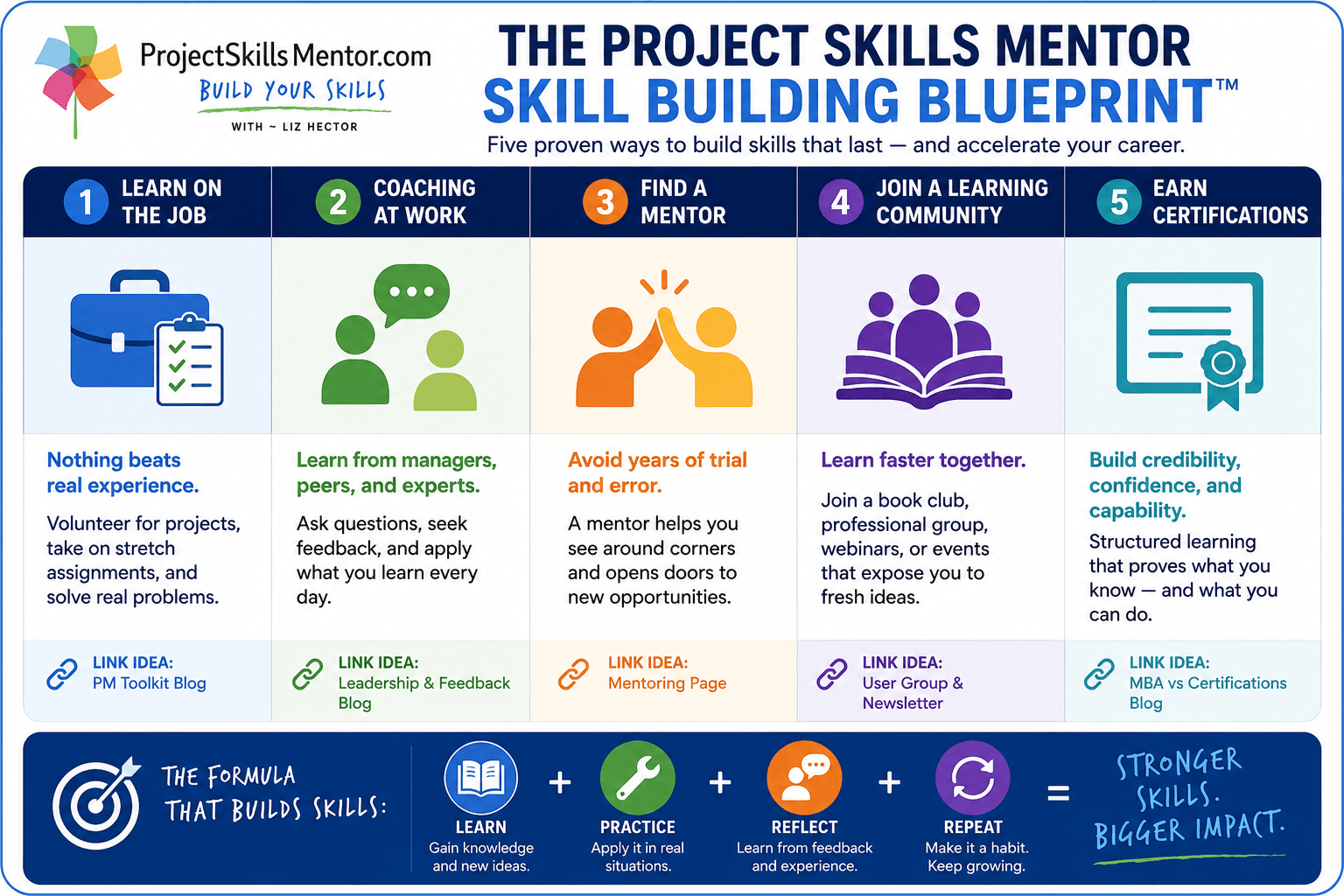
Learn on the Job
The best classroom is often the project you're working on today.
Volunteer for something slightly outside your comfort zone. That's where growth happens.
Use the Project Management Toolkit to learn the fundamentals of project management.
Coaching at Work
Don't wait for your annual performance review.
Ask your manager, "What's one thing I could do better?"
Most people are afraid to ask. The professionals who improve the fastest ask constantly.
Learn how to learn on the job here.
Find a Mentor
I've been fortunate to have mentors throughout my career. Now I enjoy mentoring others.
A good mentor won't give you all the answers. They'll help you ask better questions.
Use the Mentoring Workbook and find a mentor.
Join a Learning Community
Learning is easier when you're surrounded by curious people. Here’s how to find them.
Join a professional association - Project Managers can join IPMA, PMI, or any of the many organizations to build key skills. Google your area of interest, and you will likely find a group to join.
Attend webinars - some are free or low cost; they give you the chance to get an overview of a topic and decide if you want to learn more. And the people you meet at these online or in-person events are also valuable contacts in the future.
Watch YouTube - The free way to learn about almost anything. Don’t miss out on the community of followers as resources as well.
Read blogs - Like YouTube, blogs give you access to all kinds of free information, and if you connect with the community, you can also find a place to ask questions and learn more about the topic.
Join a book club - Readers are learners. It’s one of the cheapest ways to build knowledge. To get started, I invite you to join my business skills book club.
Earn Certifications
Degrees teach you how to think. But, certifications teach you how to do. The best career strategy often combines both. Even after forty years, I'm still earning certifications because learning never stops.
See my article deep dive into Certifications. And watch for the updated list coming soon.
Don't wait until next year to invest in yourself. Start now.
Learn one new skill. Don't wait until next year to invest in yourself. Start now.
Use it immediately. Knowledge without practice doesn't last.
Teach someone else. The fastest way to master a skill is to explain it.
Skills Are the Building Blocks
I still wonder from time to time about that marketing executive back in Silicon Valley.
Did she become a President or a CEO? I honestly don't know. I hope she did if that's what she wanted. But, as for me,I eventually earned some pretty nice titles. Manager.Director. Executive Partner.
And they were all meaningful milestones. But none of those titles built my career. The skills did.
If you're starting your career, don't spend all your energy chasing the next title.
Spend it becoming the person who can solve bigger problems, lead people well, embrace change, and never stop learning.
Because in the end, titles may get you noticed. But skills get you hired, promoted, and remembered.
So, what skills are you building this year?
I'd love to hear your answer in the comments. You never know who you might inspire to start building their own skill stack.