

Every Team Needs a Playbook: The Eurostar Chaos Case Study
When Eurostar runs smoothly, it feels effortless. Fast check-ins, predictable schedules, and efficient cross-border travel. But when disruption hits—delays, strikes, technical failures, or security issues—the experience can unravel quickly. Because the plan is …. there is no plan. And this is how Playbooks and Runbooks make a difference.

When there is no plan
Systems break down
Customers feel the chaos
Trust Fails
Nearly 80% of organizations face unplanned disruptions each year. - Gartner Report
This contrast highlights the core argument: Without a clear playbook, smooth systems can quickly turn chaotic. My experience went from a smooth 3-hour trip to an eight-hour ordeal due to poor planning, missing information, and confusion. One issue, like a broken train engine, triggered ripple effects, including ticket cancellations and refunds, escalating stress for both employees and passengers. The key lesson for managers: unexpected problems will occur, but teams with documented processes and clear roles can respond effectively and keep customers informed. Without a playbook, even minor disruptions can spiral out of control.
The fundamental difference between resilient organizations and those that spiral out of control is whether they have a playbook.
A documented playbook is what separates teams that can handle chaos from those that can't.
All teams need playbooks. Think about any football game. The managers don’t rely on instinct alone. They have playbooks for standard plays, defensive strategies, and even “Hail Mary” moments. They are prepared for almost anything that can happen. And importantly, it’s not just in their heads. It’s documented, used for training, and practiced repeatedly.
Managers in companies need playbooks too. Even if your process is simple—even if the worst-case scenario doesn’t seem catastrophic—teams that are prepared are far less likely to “fumble the ball” when pressure hits.
The Reality: Chaos Is Not Rare—It’s Inevitable
Transport systems like Eurostar operate in highly controlled environments. Yet even they face disruptions:
Infrastructure failures
Staff shortages or strikes
Weather impacts
Security incidents
Passenger surges
According to the Office of Rail and Road, rail delays and cancellations affect millions of people each year, even in well-managed systems.
Across industries, disruption is part of the job. McKinsey & Company finds structured organizations are 2–3x more effective in crisis response.
What Eurostar Chaos Looks Like (and Why It Matters)
When systems break down, patterns repeat:
Confusion
Mixed messages
Slow decisions
Escalating frustration
In your organization, that translates to:
Customers waiting
Teams are unclear on ownership.
Managers are reacting instead of leading
Without a playbook, teams face each issue as an isolated crisis, multiplying chaos instead of controlling it.
The Cost of Not Having a Playbook
Slower response times
Inconsistent decisions
Higher failure rates
Research from IBM shows structured incident processes can reduce resolution time by up to 60%.
What a Playbook Actually Does
A playbook creates clarity:
What is happening?
What do we do?
Who owns it?
It replaces hesitation with action.
How to Build a Practical Playbook (That Teams Actually Use)
This is where most organizations struggle. They either overcomplicate things or don’t start at all. To keep your playbook simple and usable, start by focusing on the top two or three scenarios your team encounters most often. Write each step in plain, direct language—avoid jargon and technical complexity. Starting small and clear makes it much less intimidating to get your first playbook off the ground.
A good playbook is simple, structured, and scenario-based.
Step 1: Start with the “Normal Day”
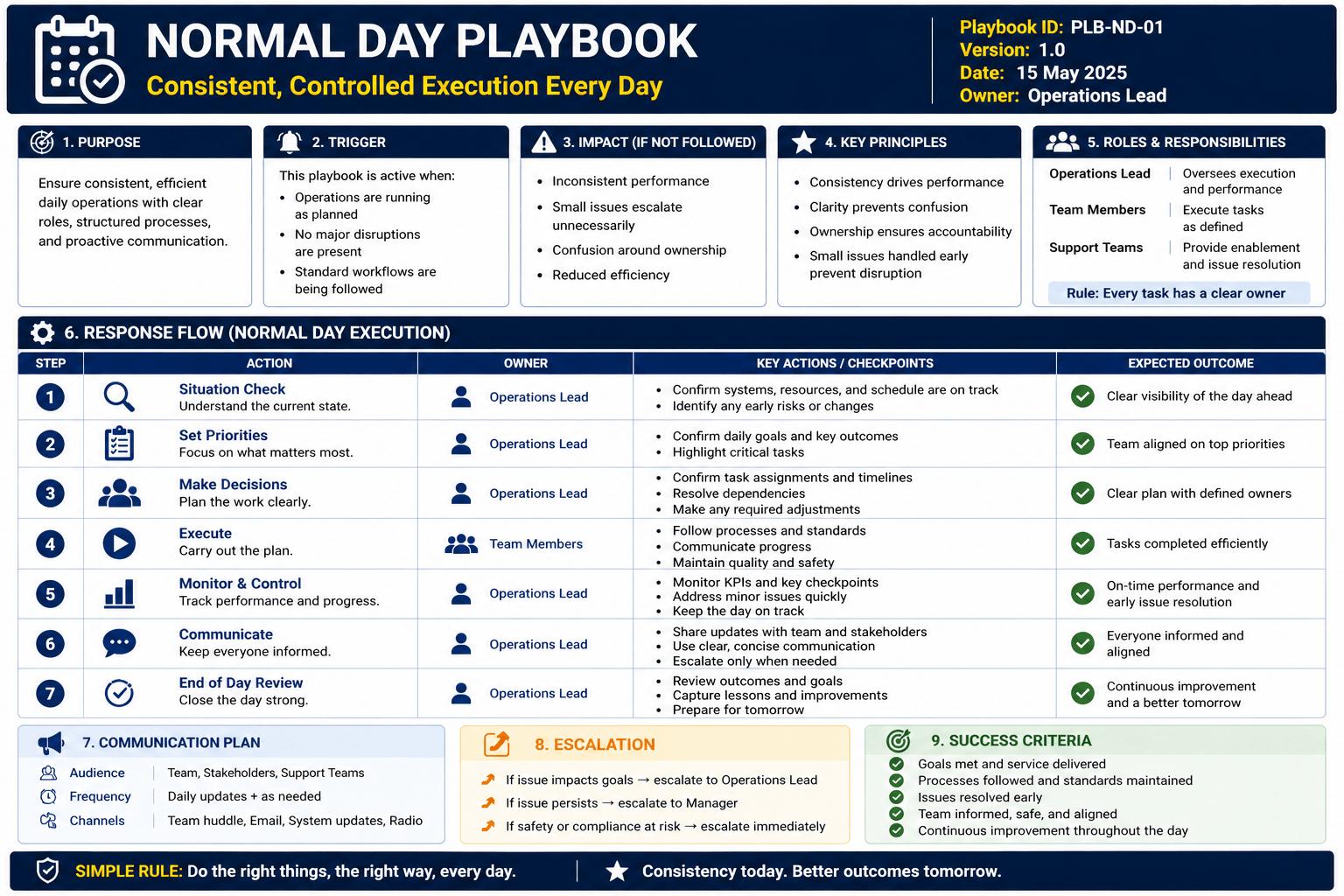
A Standard baseline helps to set the norms for operations and creates a common structure and language for the team.
Document your standard process first.
Ask:
What does success look like on a typical day?
What are the key steps from start to finish?
Who is responsible at each step?
This becomes your baseline play.
Example structure:
Trigger (e.g., customer request received)
Step-by-step actions
Owner per step
Expected outcome
If your team can’t clearly describe a normal day, they won’t handle a bad one. Try this quick team exercise: Ask each team member to write down the key steps of a typical day or process, in their own words. Compare the responses as a group. If everyone describes something different, that’s a sign your processes aren’t as clear or aligned as you might think. This simple exercise can reveal gaps and is an easy starting point for building your playbook.
Step 2: Identify the Most Likely “What If” Scenarios
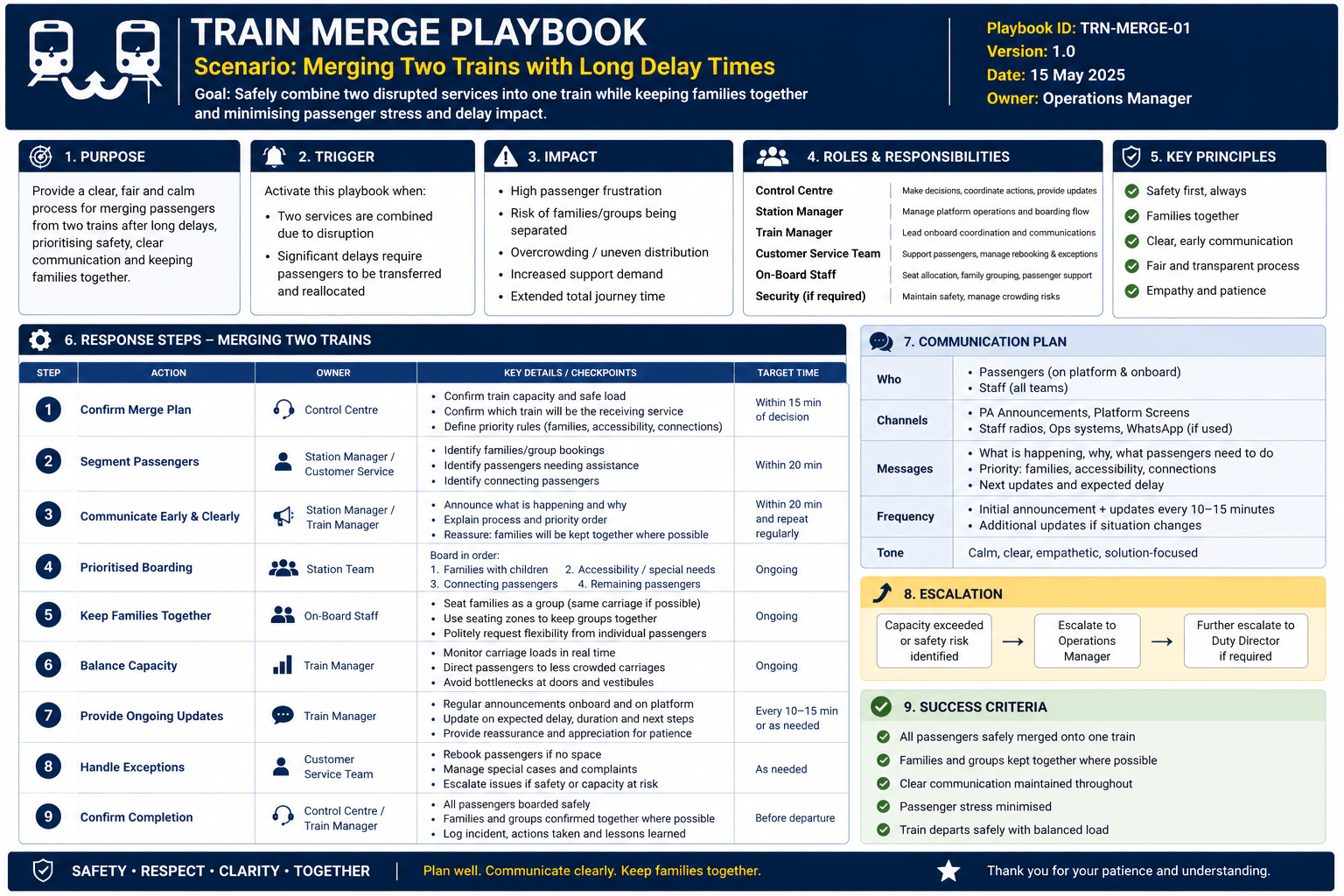
An exceptional scenario outlines the unique actions and issues a team will face in specific situations.
Don’t try to cover everything. Focus on the 2–3 most common disruptions.
For a Eurostar-style example, that might be:
Delay over 30 minutes.
System outage
Overcapacity / surge
In your business, think:
Key dependency fails
Customer escalation
Resource unavailable
Prioritize probability, not extreme edge cases.
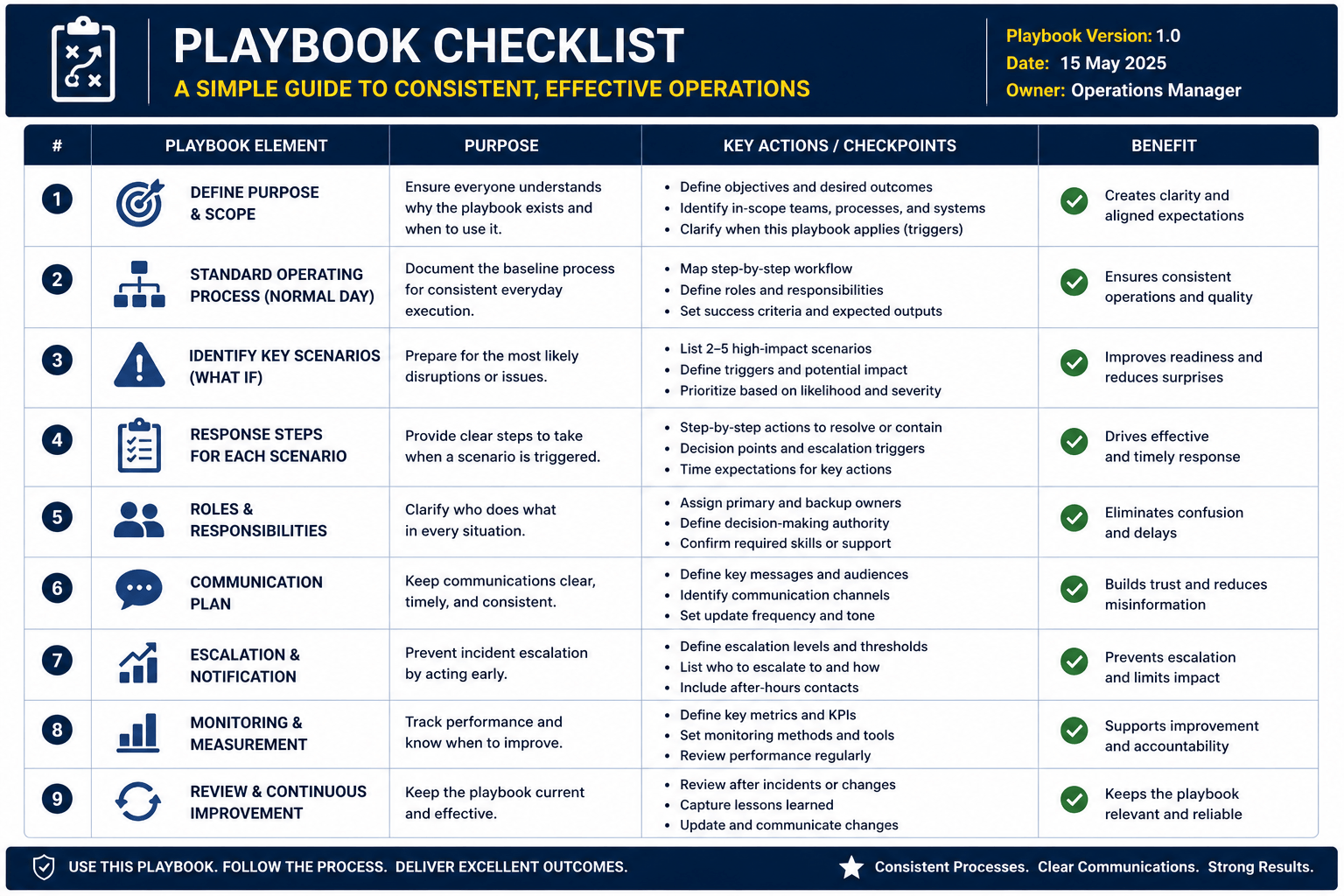
The PlayBook addresses strategic issues and conditional scenarios, and identifies types of situations (people, process, technical, etc.). It sets priorities, decision governance, and defines how plans can adapt.
Step 3: Turn Scenarios into Simple Response Flows
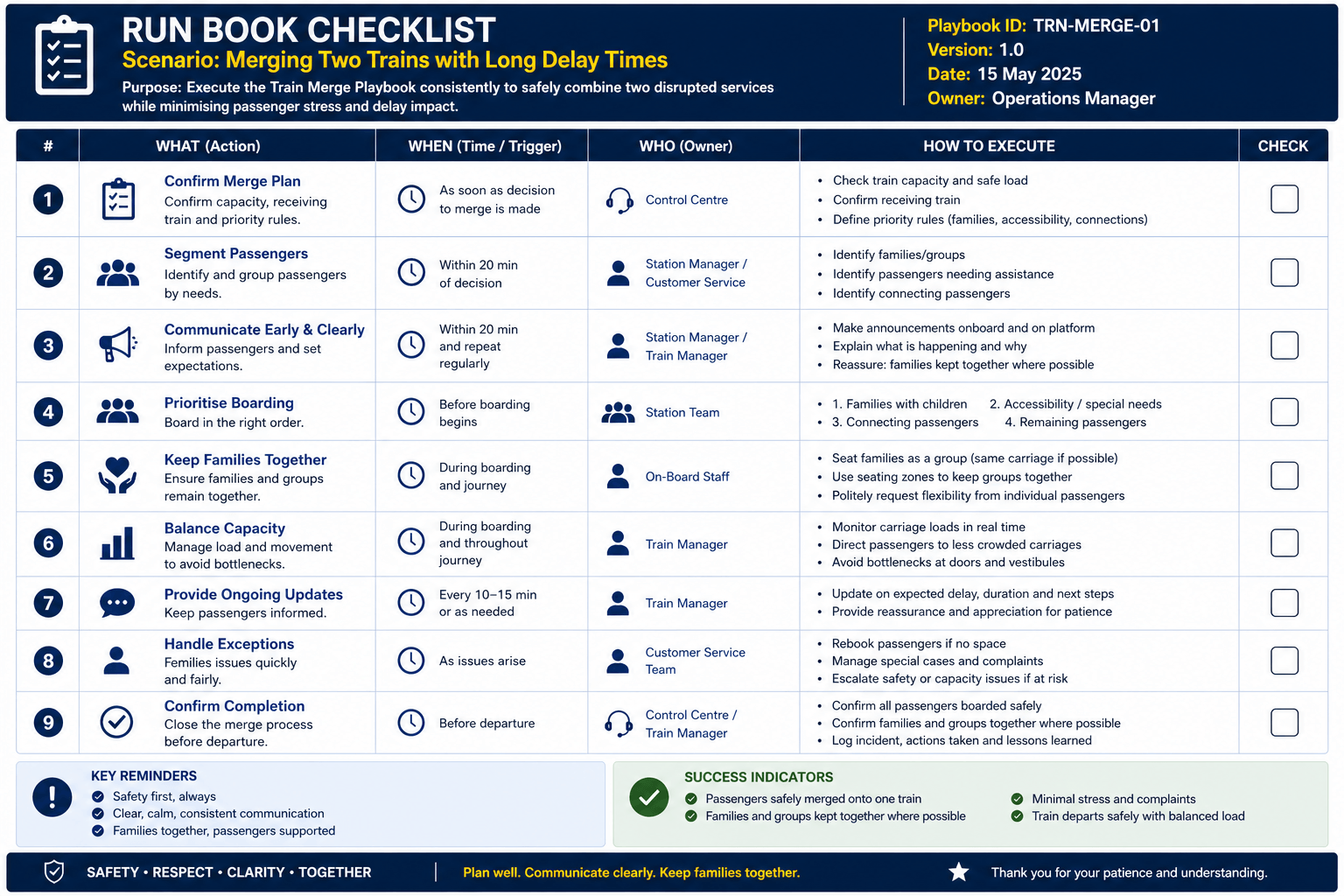
The RunBook is procedural, explicit, and repeatable. It answers issues around what, when, who, and how.
For each scenario, define:
Trigger:
When does this scenario officially start?
Actions:
What are the exact steps to take?
Roles:
Who does what?
Communication:
What is said, to whom, and when?
Escalation:
When does it move up the chain?
Keep it structured and repeatable.
Step 4: Use a Consistent Format
Every play should look the same.
This reduces thinking time under pressure.
A simple format:
Scenario name
Trigger
Step 1, 2, 3…
Owner per step
Communication notes
Escalation point
Consistency is what makes playbooks usable—not just documented.
Step 5: Test It (Before You Need It)
A playbook that isn’t tested is just a document.
Run quick simulations:
“What would we do if this happened right now?”
Walk through the steps as a team.
This is where gaps appear—and where improvement happens.
Step 6: Keep It Alive
Playbooks are not static.
After every real incident:
What worked?
What failed?
What needs updating?
Continuous improvement turns a basic playbook into a competitive advantage. For example, after Delta Airlines updated their disruption response playbook, they reduced average customer wait times by 30 percent during flight delays, leading to higher satisfaction scores and faster recovery from major incidents.
Why This Matters for Managers and Teams
For managers:
Less firefighting
More predictable execution
For teams:
Clear direction
Faster decisions
Lower stress
For customers:
Consistent experience—even when things go wrong
According to Forrester, standardized processes directly improve customer satisfaction and resolution speed.
Structure Beats Heroics
Relying on individuals to “figure it out” works—until it doesn’t.
Playbooks create:
Shared understanding
Repeatable actions
Scalable performance
They turn chaos into a controlled response.
Take Action: Build Your First Playbook This Week
Start today: Document your normal process. Begin building your team's resilience.
Add one “what if” scenario. Challenge yourself to identify disruptions your team actually faces.
Test it with your team. Run a quick simulation and find the gaps together.
Act now. Progress beats perfection. Start and iterate.
Don’t wait for perfection—take the first step toward clarity and control.
When disruption hits, your team will not improvise solutions—they will fall back on the structured system you built.
If you want a deeper, step-by-step guide to managing project risks and compliance so you can include them in your run plan, read “The Dynamic Connection and Action Between Governance, Risk Management, and Compliance.”