

Project Off Track? How to Decide Whether to Replan, Restart, or Stop
Projects rarely fail all at once. They drift.
Deadlines slip. Priorities shift. The team stays busy—but outcomes become harder to define. Stakeholders ask more questions, but fewer decisions get made.
Most failures stem from slow declines that are uncorrected early

Only about 35% of projects are considered successful.
- Project Management Institute.
The real question is not how to push harder.
It’s this: Should we replan, restart, or stop?
Continuing as planned at this stage is often the wrong decision—and usually makes recovery harder.
Project Slip vs Project Off Track
Not every problem needs a reset. Here’s a simple way to think about it:
Timeline Slip = Fix Execution (how to do that in this video)
Project Off Track = Validate, Identify, Action
If the goal is still clear and the issue is timing, you can recover.
But if outcomes are unclear, alignment is broken, or priorities keep shifting, the issue is deeper. In those cases, pushing harder won’t solve it. You need to pause and reassess.
Step 1: Validate That You’re Actually Off Track
Before making changes, confirm the situation.
This step is not about fixing anything yet—it’s about understanding whether you’re dealing with a delay or a breakdown in direction.
If you misdiagnose the problem, the response will be ineffective.
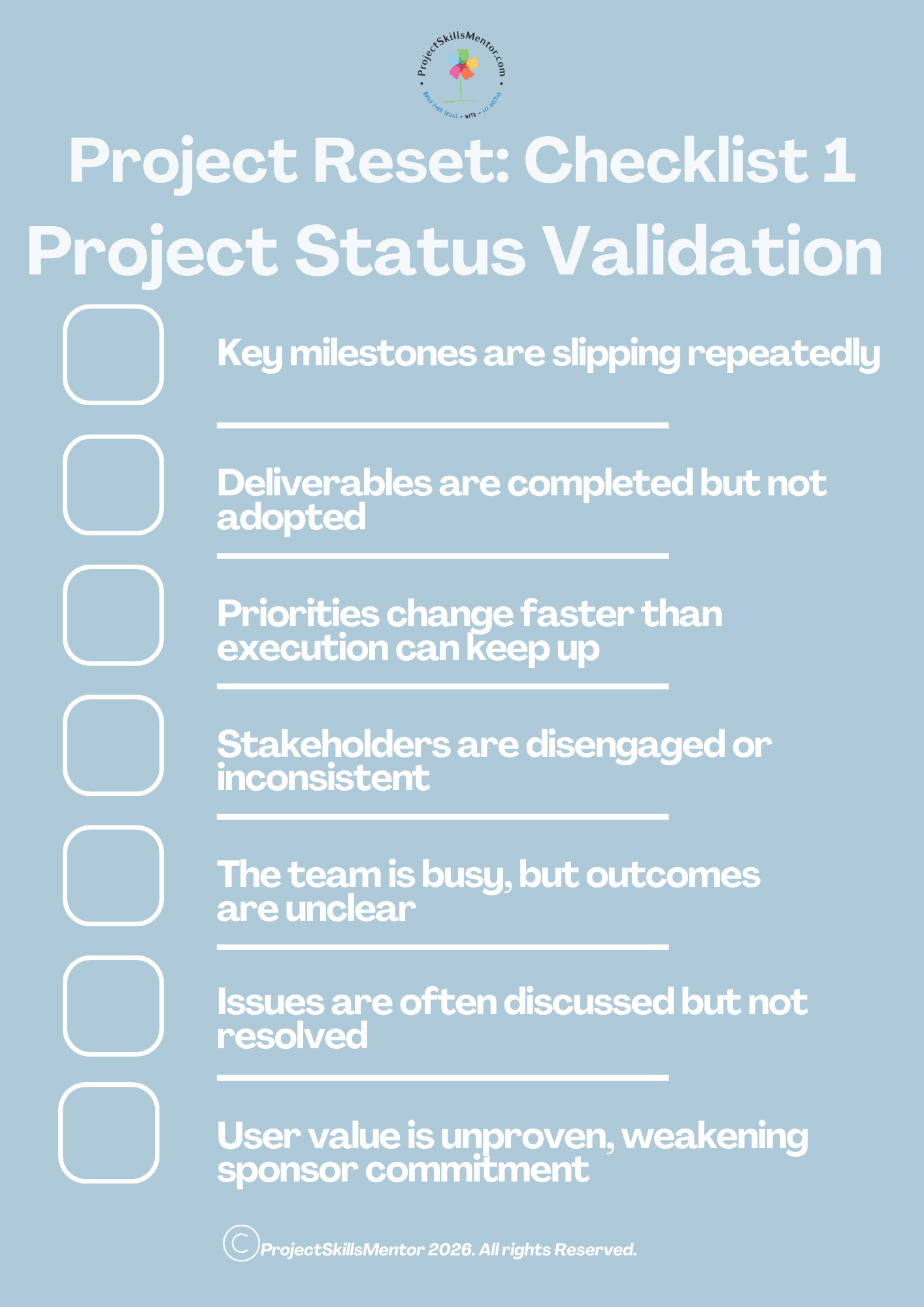
Use this checklist to determine whether it’s time for a serious project reset (and maybe consider a “hold” or “stop”).
Use this to identify whether the project is drifting beyond a simple timeline issue. If multiple signals are present, the issue is likely not execution—it’s direction.
The importance of being ready for change.
I worked on a large ‘big bang’ implementation that impacted production, distribution, and accounting.
It was an ambitious initiative, and the company's commitment was clear throughout.
Challenges arose not from system complexity, but from other factors.
The core issue was a lack of user engagement.
Users were already stretched with daily operations. They found it difficult to participate in design decisions. We tried to involve the clients’ accounting team, but received significant pushback. They were not ready for the change. They were not ready for the:
Time commitment
Workload
New solution
Despite these challenges, the project team proceeded as best they could. We completed the solution, documented all details, and delivered the outcomes requested. But when I handed over the documentation for go-live, the users set it aside.
Without being involved, they didn’t understand—or trust—it. Adoption levels were minimal.
As a result, both the project and accounting teams faced rework, confusion, and a gradual recovery period after go-live.
A system delivered without user engagement rarely succeeds; it often results in restarts. That’s why you need to know more about adding the ADKAR process and reporting to your project planning.
Step 2: Identify the Root Issues
Projects don’t drift for one reason.
They drift because something fundamental is off—often across multiple areas.
Typical pressure points tend to show up in familiar ways.
Scope grows beyond what the team can realistically deliver.
Requirements shift or remain unclear, leading to rework.
Sponsor alignment weakens, slowing decisions and creating uncertainty.
Users are not fully engaged, so value is assumed rather than validated.
Teams struggle with coordination, capacity, or unclear roles.
Technology introduces friction instead of enabling progress.
And delivery processes become inconsistent, making it harder to maintain momentum.
At this stage, don’t try to fix everything. Focus on identifying the dominant drivers.
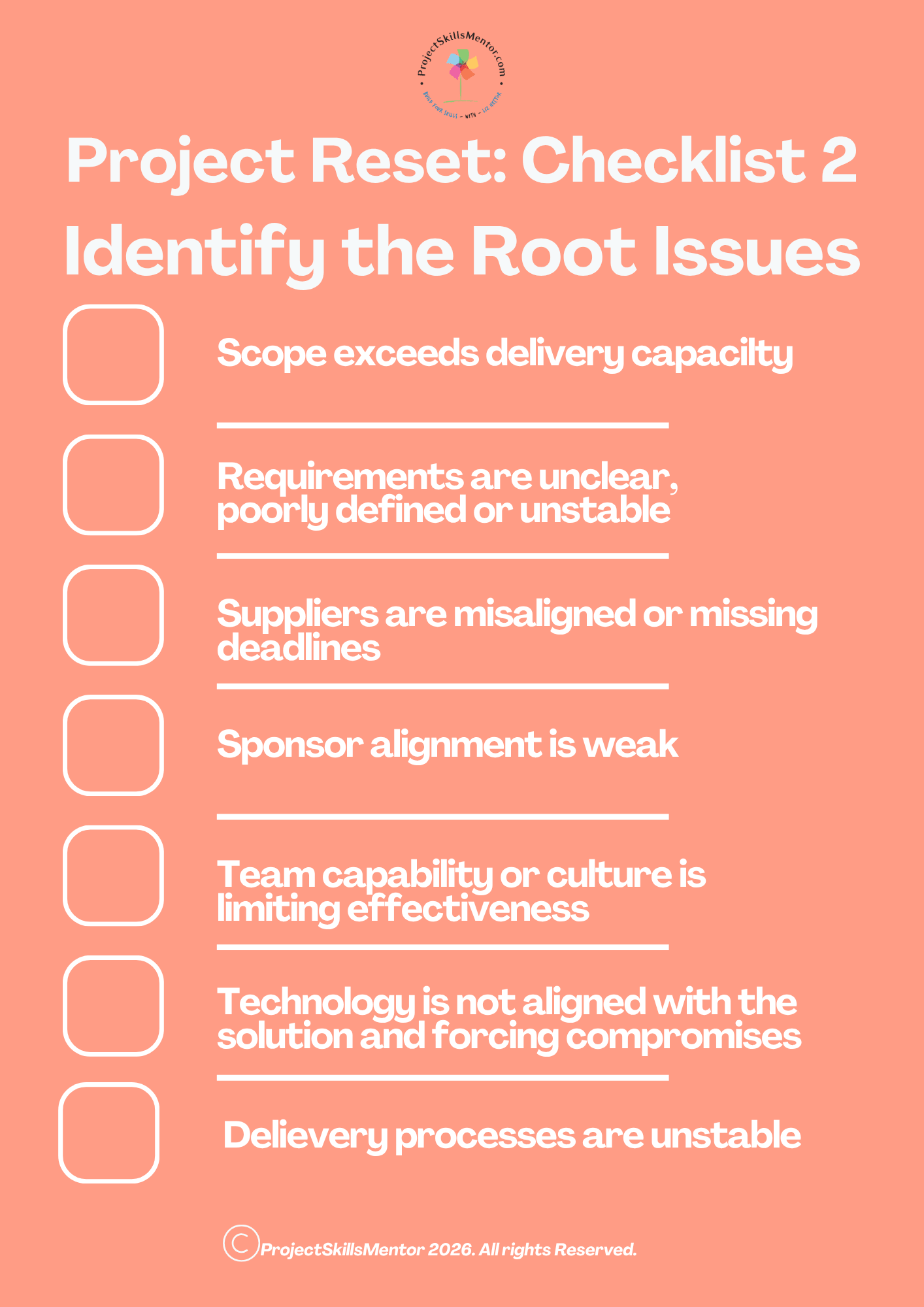
Use this checklist to assess the root causes of the problems you are seeing.
Failing to find the real issue leads to more effort, not redirection.
What works better than blame.
When projects start to slip, people often look for someone to blame.
I’ve seen it happen more than once—costs increase, timelines move, and the focus shifts from solving the problem to figuring out who caused it. On one project, we deliberately decided to handle it differently.
Instead of escalating blame, we treated issues as learning points. We brought the team together, including the customer, and worked through what was happening:
What wasn’t working?
Where were the gaps?
What could we change?
It wasn’t always comfortable—but it was productive.
We refined our processes, adjusted how we worked, and created space for better decisions.
The shift was simple:
From “Who caused this?”
To “What do we need to change?”
Projects improve faster when teams focus on learning rather than blame.
Step 3: Decide: Replan, Reset, or Stop
Once you understand what’s happening, make a clear decision.
Don’t default to “keep going.”
Replan (Adjust execution, keep direction)
Use this when:
The business case still holds
Priorities are stable
The problem is execution.
Replanning works when the direction is still valid.
Reset (restart with a clearer foundation)
Use this when:
Priorities have shifted
User needs were misunderstood.
Scope no longer reflects reality.
Restarting is often avoided—but it’s often the fastest way back to a viable outcome.
Stop (Prevent further loss)
Use this when:
Value is unclear
Costs outweigh benefits
There is no realistic path to success.
Stopping a project is not a failure.
Continuing a misaligned project is.
The time I didn’t stop.
A challenging lesson surfaced from a project I continued longer than advisable. The contract had shifted from time-and-materials to fixed cost. Meanwhile, the client remained closely involved as the primary decision maker.
That combination works on a time-and-materials basis.
It doesn’t work as well in fixed costs.
As change requests increased, the impact on delivery grew—but the decision-making behavior didn’t change. The team continued to deliver despite misalignment. Adjustments were made and managed within existing constraints. A pause-and-contract reassessment was necessary. Reevaluating the contract and realigning expectations was needed.
That step was not taken.
The project experienced significant difficulties as a result.
Sometimes, the best course is to pause, reassess, and reconsider the conditions for success.
Step 4: Create a Common Vision
Why Alignment Matters
When projects run for months or years, alignment naturally erodes. New stakeholders arrive, priorities evolve, team members change roles, and new people join the project. Even when everyone is working hard, people can develop different understandings of the goals, priorities, and expected outcomes.
Misalignment often shows up as:
Conflicting stakeholder expectations
Delayed decisions
Increasing rework
Resistance to delivered solutions
Teams are working efficiently, but not on the right things
Reduced confidence in the project
The longer a project runs, the more important it becomes to deliberately create opportunities for alignment.
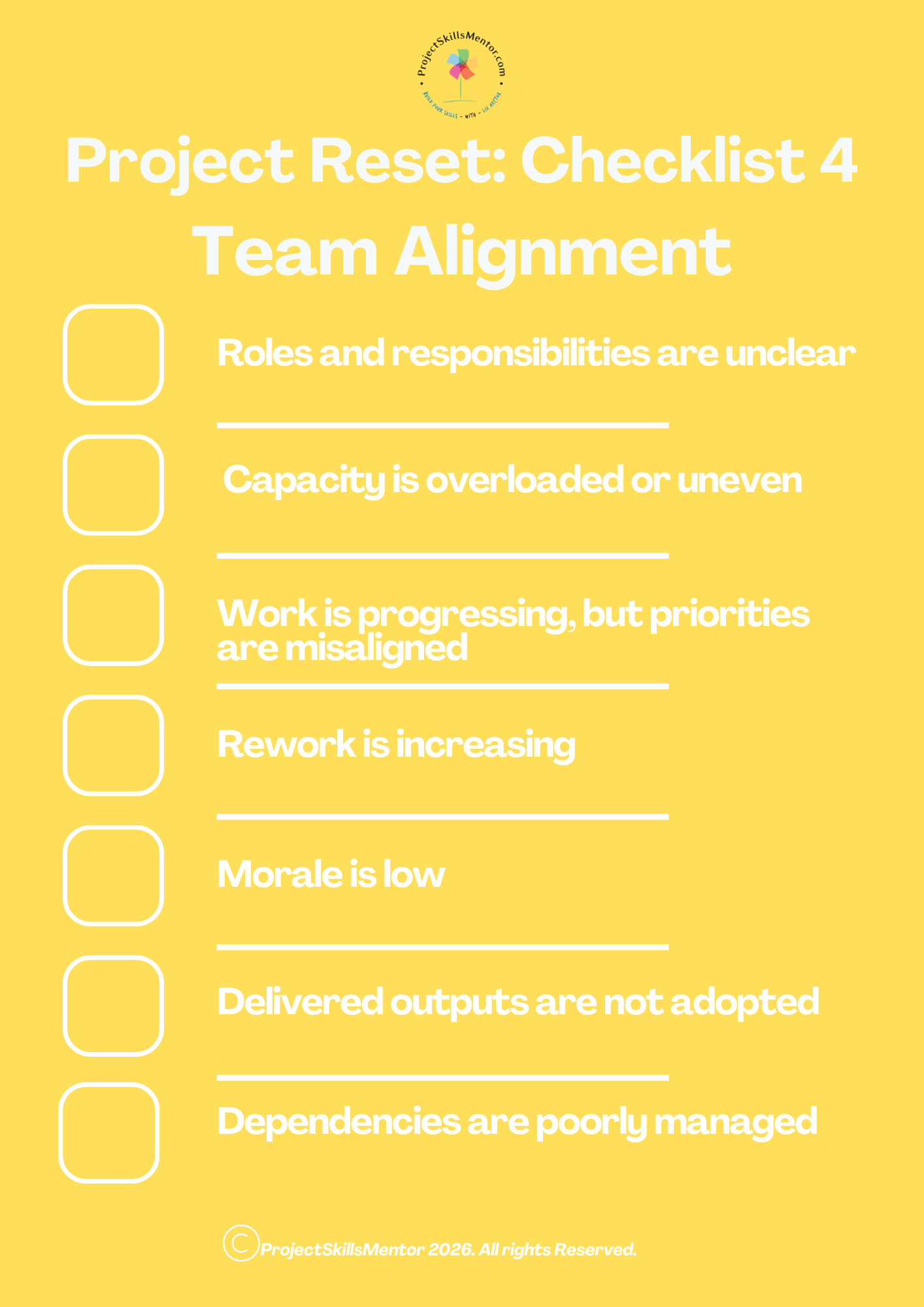
If you don’t fix what wrong for the team, you cannot move forward.
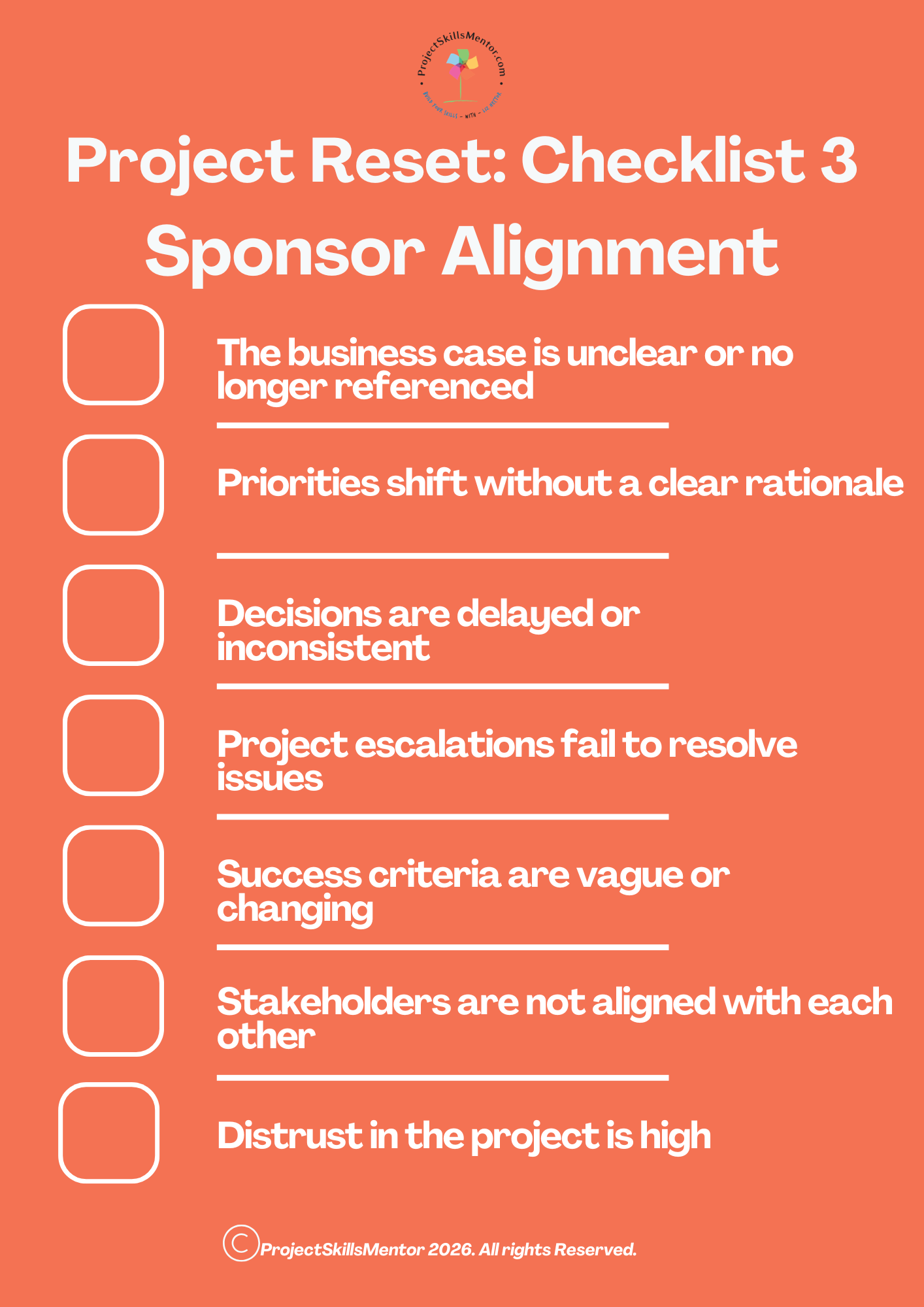
If the Sponsors and other stakeholders don’t trust the process and outcome, they won’t trust you.
Learning together is aligning together
One of the most effective techniques I've used on large, long-running projects was conducting regular learning workshops.
On one project, we welcomed new customers every year, engaged new stakeholders regularly, developed new content, and onboarded team members to new roles. Keeping everyone aligned could easily have become a challenge.
Rather than relying on project documentation alone, we created fit-for-purpose learning workshops.
For the delivery team, the workshops focused on:
The end-to-end process
How work flowed through the project
How users would experience the outcomes
The impact of decisions on customers and colleagues
These discussions helped create a shared understanding of not only what we were doing, but why we were doing it.
For stakeholders and end users, the workshops focused on:
Expected outcomes
Business value
User experience
Key decisions and priorities
We also provided enough visibility of the delivery approach to help participants understand how work was being managed. This gave stakeholders confidence that the project was under control and that they were in good hands.
The result was a common understanding across sponsors, stakeholders, users, and delivery teams. Decisions became easier, feedback became more meaningful, and expectations remained aligned.
Alignment at the beginning of a project is valuable. Alignment during a project reset is essential.
If you did not create these opportunities at the start of the project, create them now. A reset is the perfect opportunity to bring everyone together, rebuild shared understanding, and establish a common path forward.
How We Kept Everyone on the Same Page.
Alignment is not a one-time activity.
Projects with changing stakeholders, evolving teams, and long delivery timeframes require deliberate moments to reconnect people with the purpose, outcomes, and approach. We ran annual workshops with our team to discuss our way of working and build empathy for the user experience. We also held workshops with new and experienced stakeholders to gather feedback on the outcomes and discuss our processes to ensure that they were ‘in good hands’.
If your project is being reset, start by getting everyone back on the same page. This single action can prevent many of the issues identified in both the Sponsor Alignment and Team Alignment checklists
Step 5: Take Action
After completing the checklists, step back and look at the overall picture. The goal is not to prove that the project is failing. The goal is to understand whether the current approach can still deliver the intended outcomes.
Projects rarely recover simply because people work harder. Recovery happens when leaders make deliberate decisions based on evidence rather than optimism.
Once a decision is made, act quickly and clearly.
Avoid vague next steps. Focus on what actually needs to change.
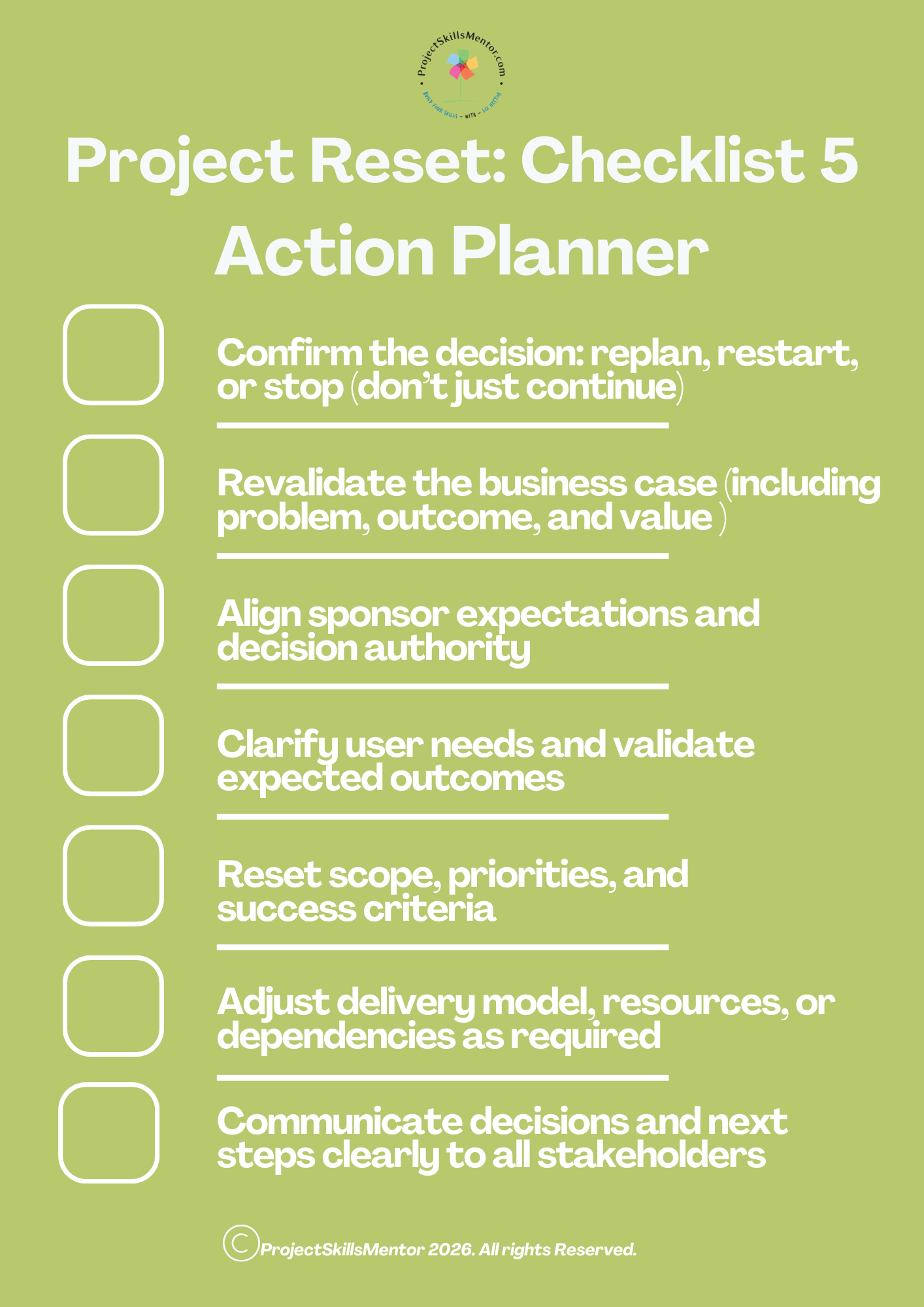
Use this checklist to selectively focus on actions that will fix the root causes and allow you to make the right decision about the future of the project.
Before You Continue.
Sometimes, taking action feels like a moment to just start doing and stop reviewing. And that is true, but to regain long-term control, you need to commit to the processes of documentation, collaboration, and communication.
Regardless of whether you choose to replan, restart, or stop, take time to:
Revalidate the business case
Confirm the desired outcomes
Align stakeholders on success measures
Clarify decision-making authority
Understand user needs and expectations
Communicate the decision clearly
Projects succeed when everyone understands not only what is changing, but why it is changing.
The most important outcome of a project reset is not a revised schedule or a new plan. It is a shared understanding of the path forward.
This step translates your decision into practical changes in execution. Clarity of action matters more than speed of action. Projects succeed when everyone understands not only what is changing, but why it is changing.
The most important outcome of a project reset is not a revised schedule or a new plan. It is a shared understanding of the path forward.
A quick word on the Business Case.
If you are planning to restart, your stakeholders may ‘hold you to the old business case’. Beat them to the punch by reviewing the document and resetting the goals consistent with the changes needed to get the job done. This includes scope reduction, budget changes, and increased staffing.
Reset it clearly:
What problem are we solving?
What outcome defines success?
Does this still matter to the business?
How will we execute this new plan?
Is the value vs cost still relevant?
If these answers aren’t clear, the project direction needs to be reconsidered. Need more information on making a successful business case? Read this article next.
If you want to get the checklists I have shown today, you can download them here.
Step 6: Keep the Trust You Have Rebuilt
When restarting the project, remember that the goal is to stay on track. That means putting early warning signs in place to avoid another failure. So plan to meet more, align more, communicate more. And create the signals to avoid a replay of the failure.
Watch for:
“Let’s just push through” without clarity.
Increasing activity but declining outcomes
Stakeholder disengagement
Frequent priority changes
Growing disconnect between plan and reality
If these signals return, act early. Recovery becomes much harder later.
Now that you’ve decided what to do, deliberately rebuild alignment (and trust)
Focus on three areas:
Sponsor
Are priorities clear? Are decisions being made consistently? Get my free Guide to Stakeholder Management.
User
Are needs validated? Are outputs actually being used? Learn how to protect your solution with a User Group.
Team
Are roles clear? Is the capacity balanced? Are dependencies managed?
Most struggling projects are not just delivery problems—they are alignment problems. Learn more about High-Performing Teams.
What about when only a few members of the team work remotely? Read my article on hybrid teams.
Step 7:
Before You Push Harder
When a project starts to drift, the instinct is to push harder.
More effort. More meetings. More urgency. Sometimes it works.
Sometimes that works.
But often, it just takes you further in the wrong direction.
The real shift is this:
Not how do we deliver faster?
But should we still be delivering this at all?
Step back. Look clearly. Make the call. Then move forward with intent.