

When Your Project Timeline Slips: A Practical, No-Drama Playbook for Project Leaders
No project manager enjoys delivering bad news—especially when it means telling stakeholders that the go-live date is slipping. But here's the truth: stakeholders don't dislike delays as much as they dislike surprises. A slip handled transparently and professionally can actually build credibility. A slip hidden until it becomes impossible to ignore can destroy it.

How to Fix Your Project
Assess the Issues
Be Honest with Stakeholders
Rework the Plan
Check the Costs
Engage the Team
“More than 30% of technology development projects were over budget and late.”
When you realize your timeline is at risk, the goal isn't to panic or scramble for excuses. The goal is to lead. Below is a structured, real-world playbook to help you navigate timeline slips with confidence, accuracy, and minimal chaos.
The fact is, project slippage or overruns are common, especially for IT implementations or major change management projects. There are several well-documented reasons why. Projects tend to fail based on one or more key areas. Depending on the situation, these topics may be plaguing your project. See the article links to see how you can turn potential failure into success:
What’s the impact of these project overruns, slips, and failures? Time and money, but also reputation failure. And project delays and overruns may be more common than you think, as this McKinsey study shows.
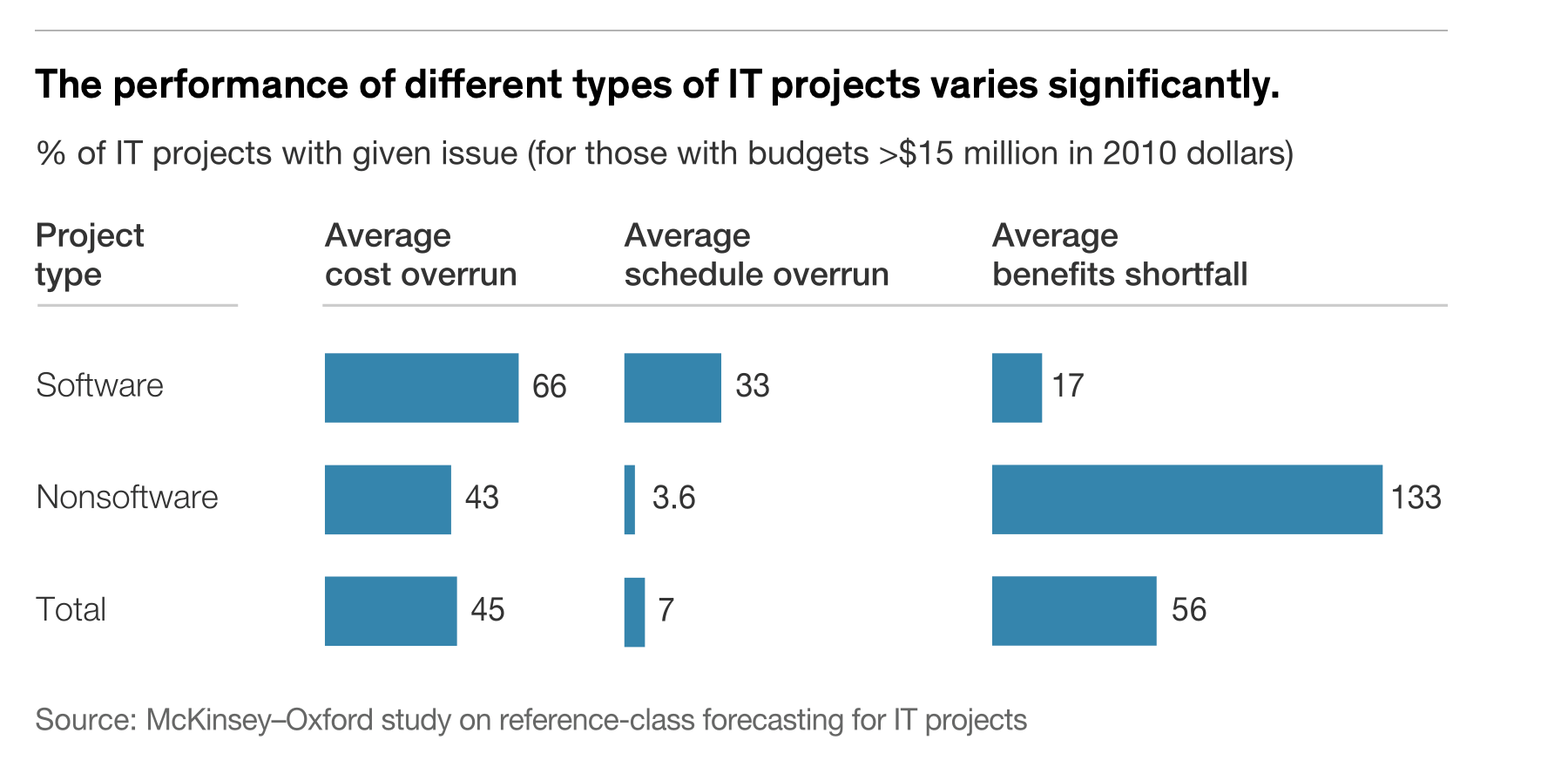
Source: https://www.mckinsey.com/capabilities/tech-and-ai/our-insights/delivering-large-scale-it-projects-on-time-on-budget-and-on-value
1. Diagnose the Root Causes and Know Exactly What's Slipping
Before you speak to anyone about the delay, get your facts straight.
Identify the precise tasks and milestones that are behind.
Understand how each delay cascades into subsequent phases ("the daisy-chain effect").
Recalculate the true impact on overall delivery—not the optimistic version, but the operational reality.
This clarity becomes the backbone of every conversation that follows. If you can't articulate why the plan is slipping, you can't justify how you intend to fix it.
2. Present the Current Plan vs. the New Plan
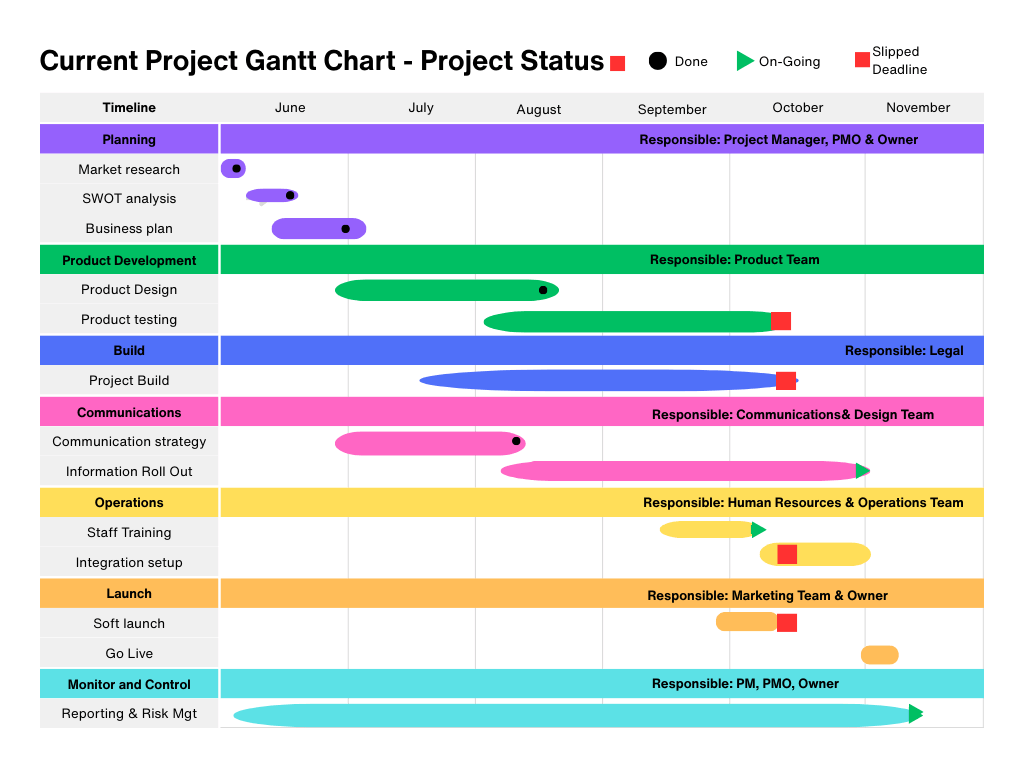
Share the current plan and highlight the deadline slippage.
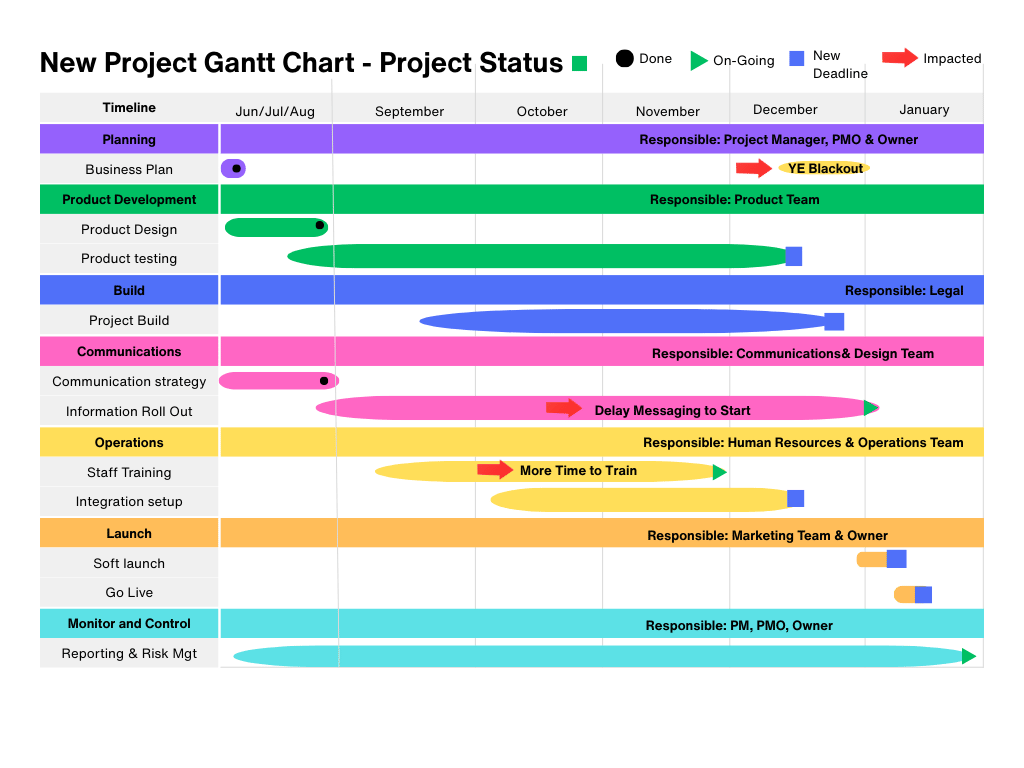
Show the new plan, changed dates, and impacted activities.
Transparency earns trust.
Prepare a side-by-side comparison of:
The original timeline
The revised timeline
Each step and milestone shows its updated timeframe
Don't just say the date is later—show the math. People accept delays when the logic is visible.
A proactive approach to contingency planning empowers project leaders and prepares them for uncertainties. A revised timeline without contingency is just another optimistic forecast waiting to fail.
Add reasonable buffers to:
High-risk tasks
Dependencies outside your control
Integration or testing activities are known to be volatile
This is your chance to avoid having to return with yet another slip later.
3. Know the Financial Impact
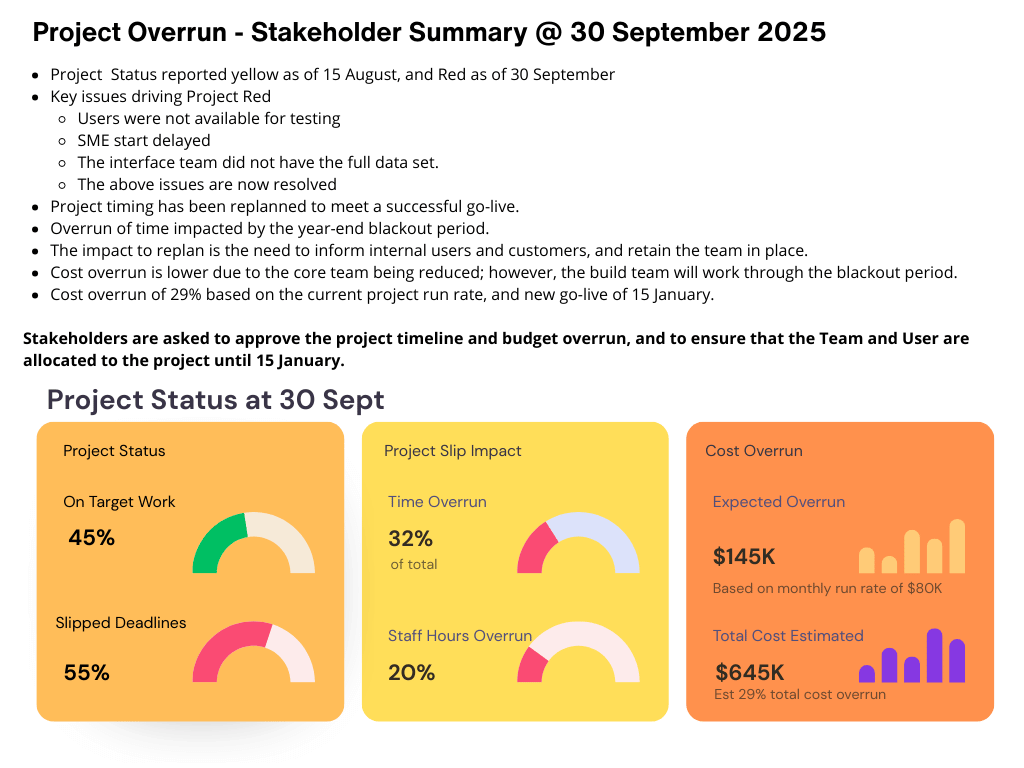
Create a summary page to highlight the ‘why’, ‘what’, and ‘how much’ of your project's missed deadlines.
Understanding the financial implications demonstrates accountability. When you know the current run rate (how much the project costs to run each month), the impact on staffing, you demonstrate an understanding of the business impact. Stakeholders can assess the damage and make informed decisions when they understand the impact on the budget, time, and outcome.
To calculate the numbers, make sure you have the following data to present.
Percentage of work slippage vs work completed (e.g., 45% of work is on track and 55% of task deadlines are missed)
Monthly burn rate (e.g., $100K/month)
Length of slip (e.g., 3 months)
Additional spend (e.g., $300K)
Percentage increase relative to total project cost (e.g., total of initial cost + additional costs / initial costs)
Then go a step further—show cost-takeout options:
Can consultants or SMEs whose work is not part of the delay temporarily reduce their hours while the other teams catch up?
Can internal resources shift to other work until the delayed phase picks up?
Are there fixed vs. variable cost components that can be optimized?
This positions you as a partner in financial stewardship rather than just the messenger of bad news.
4. Reassess the Risk Register
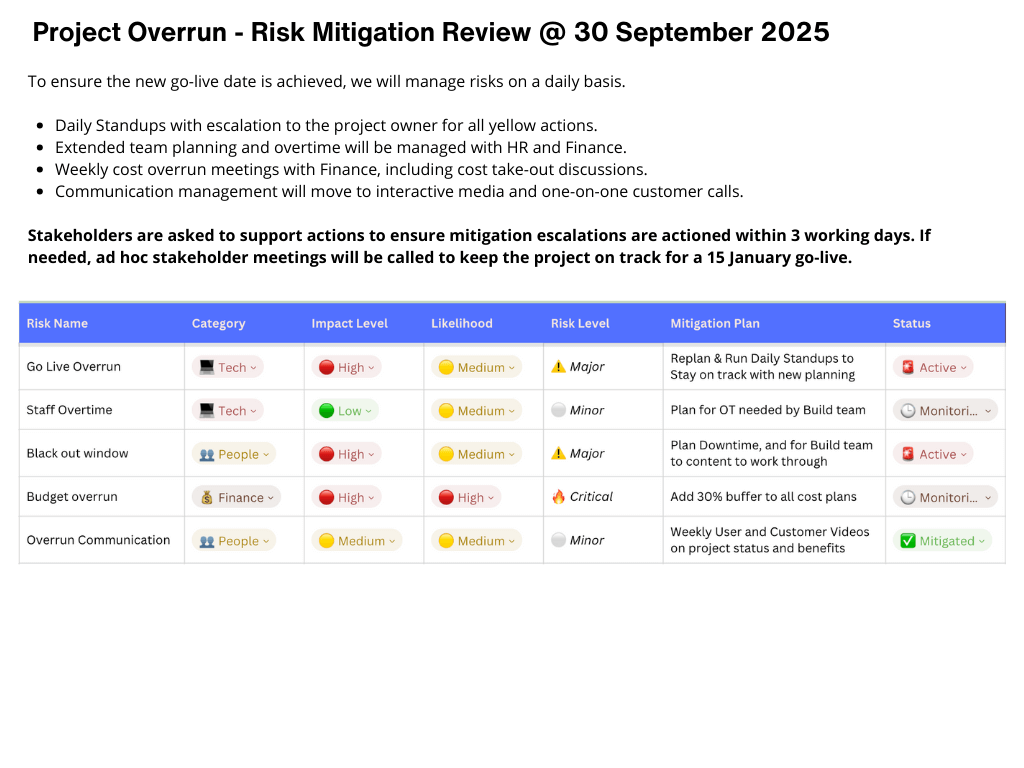
Update the risk register to address the issues that derailed your project. Show how you and your team will ensure that the issues are addressed. Set expectations with stakeholders that asks for help to implement solutions to the issues in advance.
A delay changes your risk profile.
Some risks are reduced (e.g., rushing testing, tight integration windows).
New risks emerge (e.g., resource availability in a new timeline window, user fatigue).
Update your risk register to show:
Which risks are de-escalated
Which new risks appear
How you'll mitigate them
This demonstrates forward thinking and control—not chaos. And don’t forget the key audience for the change to the plan and risk management - your team. Don’t hold back from sharing the good, the bad, and the ugly. They need to know how things will be managed to get the team and project back on track. So plan a meeting to review the replanning schedule. And share the impact on workload planning, including overtime, reduced time, and increased oversight.
5. Validate the New Go-Live Window With the Business
Reassessing the go-live window involves managing stakeholder expectations- such as sales, regulatory bodies, and customers—to ensure alignment and maintain trust during delays. A technically feasible date may be operationally unacceptable. Validate alignment before proposing your new timeline. You need to check the new date in advance with the business owner. Once you have the project delay impact, you will need to consider additional go-live delays in terms of business windows or ‘black-outs’. These are periods when project go-lives are not allowed.
Check for conflicts with:
Sales cycles
Peak customer traffic periods
Regulatory deadlines
Fiscal-year constraints
Other projects with approved launch date
Holiday periods
Organizational blackout windows
You may also need to coordinate your go-live with other projects to ensure that your project's go-live date change does not impact them. This can happen if your project is a precursor to other projects rolling out in the same period.
6. Identify Who Is Impacted and How You'll Communicate
The slip affects far more than the project team.
Think through impacts to:
Stakeholders and sponsors
Finance and budget owners
End users
Customers
Change management and training schedules
Operations or support teams
The communication plan should be tailored to different stakeholder groups, such as sponsors, end users, and support teams. Ensure messaging is effective, engaging, and minimizes frustration or surprises. Delays can undermine your team's hard-won engagement work, so you will need to rethink how to maintain momentum and messaging.
7. Prepare for an Emotional Response (and Don't Get Pulled Into the Drama)
Timeline slips trigger emotions such as blame, anger, frustration, and defensiveness. Stay calm and factual. Be prepared for the meeting with the key information (as shown above). You should be ready to answer:
Why did this happen?
What are you doing about it?
How will you prevent another slip?
What are the financial implications?
Check your contracts too:
Do delays trigger change orders?
Are there penalties, extensions, or notification requirements?
Are partners or vendors obligated to adjust scope or cost?
Know that bad news is never appreciated. But this too shall pass. Don’t take the anger personally, but do take their issues on board. Show that you are listening. Ask for their feedback. Make clear statements about the help and approvals you need to complete the project. Confirm all agreed actions and follow up in writing after the meeting.
Emotional storms may fade quickly when leaders speak with clarity, reason, and solutions. Don't get sucked into the drama. Stay cool and keep your answers fact-based. If you don't know, say so, then find out the answer and follow up.
8. Don't Delay Action, Assess and Move Fast
The worst reaction to a delay is inaction. Some teams freeze after delivering bad news, hoping things stabilize on their own. But failing to adjust staffing, scope, or planning only magnifies the impact of the slip. You will get blamed if you knew the project was doomed to fail and did nothing to address it.
Act quickly to:
Rebaseline the plan
Adjust resource allocation
Update budgets and forecasts
Engage vendors
Formalize change control
Momentum is your friend. Hesitation is your enemy.
9. Increase Team Check-Ins and Strengthen Operational Discipline
Recalibrating a project creates a lot of moving parts. For the next few weeks:
Increase standups. Move your management checkpoint meetings from weekly to daily or every other day
Tighten communication loops. More, not less, communication is needed to get the ship back on track.
Clarify KPIs. Track and share the project data with everyone. Use large posters around the team room as a ‘punch list’ for work that is on the critical path. Share delivery and reporting expectations without overwhelming your already stressed team.
Don't be a bully. It is easy to blame the team, but remember to show leadership by addressing the issues, not the individuals.
If you need to address poor performance, do so as you would in any other situation, privately, formally, and with documentation.
Lead by example. Share your concerns but also your confidence in the team’s ability to meet the new goals.
Your team should see that project work is organized and in control. Your stakeholders must see structured progress. Frequent, focused communication maintains alignment and reduces anxiety.
A Slip Is Not a Failure, Silence Is
Handled professionally, a project slip can actually showcase strong leadership. It proves you are:
Monitoring reality, not fantasy
Speaking honestly, before things become critical
Managing financial responsibility
Protecting the business
Leading your team through change with confidence
The fact is, sometimes projects slip. How you respond is important. (We've all been there. You're not alone.)
With your good leadership, through clarity, calmness, control (and kindness), you can claw back victory from defeat.
Let me know in the comments below how I can help you. In the meantime, you may find help with these articles or videos.