
Whose Interests Are Driving Your Project Decisions?
A decision can be reasonable and still be wrong for the project.

“Complexity doesn’t just appear at delivery—you can anticipate it from the very start, in the way objectives are set and how stakeholder interests collide.”
— Joseph Uwazie
PMI Pulse of the Profession 2026
Project decisions rarely rely on facts alone. Power, history, reputation, compensation, workload, fear, and personal ambition shape them. Most stakeholders do not enter a meeting intending to damage a project. However, a decision that is rational for an individual can still harm the project and the organization.
That is why project managers need to ask an often uncomfortable question: Whose interests are really driving this decision?
This is not a question about accusing people of dishonesty. It is a question about governance. If one influential stakeholder can redirect a project without showing how the decision supports the agreed business case, the organization may fund one outcome while the project quietly delivers another.
When Old Thinking Stalls New Decisions
Consider an organization that signed a contract to implement a new enterprise resource planning system. The original intention was to improve and integrate its processes and data. After signing the contract, however, the client began moving toward a different approach.
Instead of using the implementation to simplify and standardize the business, the current solution owner wanted to preserve the legacy system's processes and data structures. Essentially, they wanted to redesign the new system to look and operate like the old one. Maintaining the status quo may have felt safer and more familiar for the stakeholder. However, short-term personal comfort should not determine a solution the organization will rely on for years. The likely result was a solution that would be more expensive to implement and maintain. Because it is not optimized for either the old or the new way, it often also creates a worse user experience. This happens when decisions lead to both buy and make.
How does a Project Manager address a situation like this one? The warning sign isn't stakeholders’ reluctance to adapt. The warning sign is a project changing direction without a transparent, independent assessment of whether the new approach still supports the business case.
When the Steering Committee Goes Off Course

Choosing between two project decisions with different organizational consequences.
I saw a different version of the same problem while serving on the steering committee of a large process-improvement project. The project team’s goal was to create and implement better processes. Yet the steering committee meetings were highly political and heavily influenced by optics around several external members, which caused the project objectives to veer off course.
A steering committee protects the project’s business case, provides strategic direction, resolves escalated issues, and makes decisions beyond the project manager’s authority. It ensures the project continues to deliver value for the organization.
The project's ineffective steering group had serious consequences for the company. The team did not receive the support it needed, and the steering committee did not resolve escalated issues effectively. The budget got spent, the team got demoralized, and the project delivered a substandard product to the company and users.
Some steering committee members had expressed doubts about the project from the beginning. That is a self-fulfilling prophecy: predict failure, deny the project the decisions and support it needs to succeed, and then use the resulting failure as evidence that the prediction was right.
This problem has a name. In fact, it has several.
The principal-agent problem
The company—the principal—delegates authority to a manager, sponsor, consultant, or steering committee member—the agent. The problem arises when the agent has information and decision-making power but priorities that differ from the organization's.
The stakeholder may favor a decision that protects a role, bonus, reputation, department, supplier relationship, or legacy. The decision may make complete sense from that stakeholder’s point of view while reducing the organization's long-term value.
Escalation of commitment
People become attached to systems, strategies, and decisions in which they have invested time, money, credibility, and emotion. Research into information systems projects identifies escalation of commitment as a reason decision-makers continue supporting an ineffective course of action despite negative feedback.
A legacy system is rarely just technology to the person who built or managed it. It may represent years of achievement and professional identity. Replacing it can feel personal, even when the business need for replacement is clear.
Governance theater
A project may have a steering committee, status reports, escalation paths, and approval gates and still lack effective governance. Governance becomes theatre when meetings show oversight exists but fail to produce timely decisions, remove obstacles, protect benefits, or hold stakeholders accountable for outcomes.
The Business Cost of Misaligned Project Decisions
No reliable statistic shows what percentage of projects are damaged specifically by stakeholder self-interest. Organizations rarely record a failed decision as ‘the sponsor protected a personal incentive.’ Instead, the effects appear as scope changes, excessive customization, unresolved escalations, weak sponsorship, rework, benefit erosion, or failure to meet the business case.
The broader evidence nevertheless shows why this issue matters: PMI’s 2026 research found that 97% of project professionals managed at least one complex project in the previous year. About one-third of complex projects failed, compared with a 13% failure rate overall. Project professionals who managed complexity effectively increased the likelihood of project success fivefold.
PMI’s 2025 research found that only 18% of project professionals reported high business-acumen proficiency. Business acumen matters because project leaders must test decisions against strategy and long-term value, not only scope, schedule, and budget.
A U.S. Government Accountability Office review of a major business-systems modernization effort offered a particularly relevant conclusion: ‘Incentives for its decision makers to implement behavioral changes have been minimal or nonexistent.’ When the people controlling a transformation are not rewarded for transformation, resistance should not surprise us.
Seven tests for a stakeholder-driven decision
When a major decision could change the project’s direction, the project manager should not wait until the meeting to challenge it. Before the meeting, share the decision to be made, the available options, and their impact on the business case. During the meeting, use these seven tests to guide an objective discussion. Not to question anyone’s motives. After the meeting, document the decision, assumptions, risks, expected benefits, accountable owner, and review date.
Return to the business case.
Separate enterprise needs from personal preferences.
Make the trade-offs visible.
Ask who benefits—and who pays.
Seek an independent challenge.
Check the decision rights.
Record the decision and its owner.
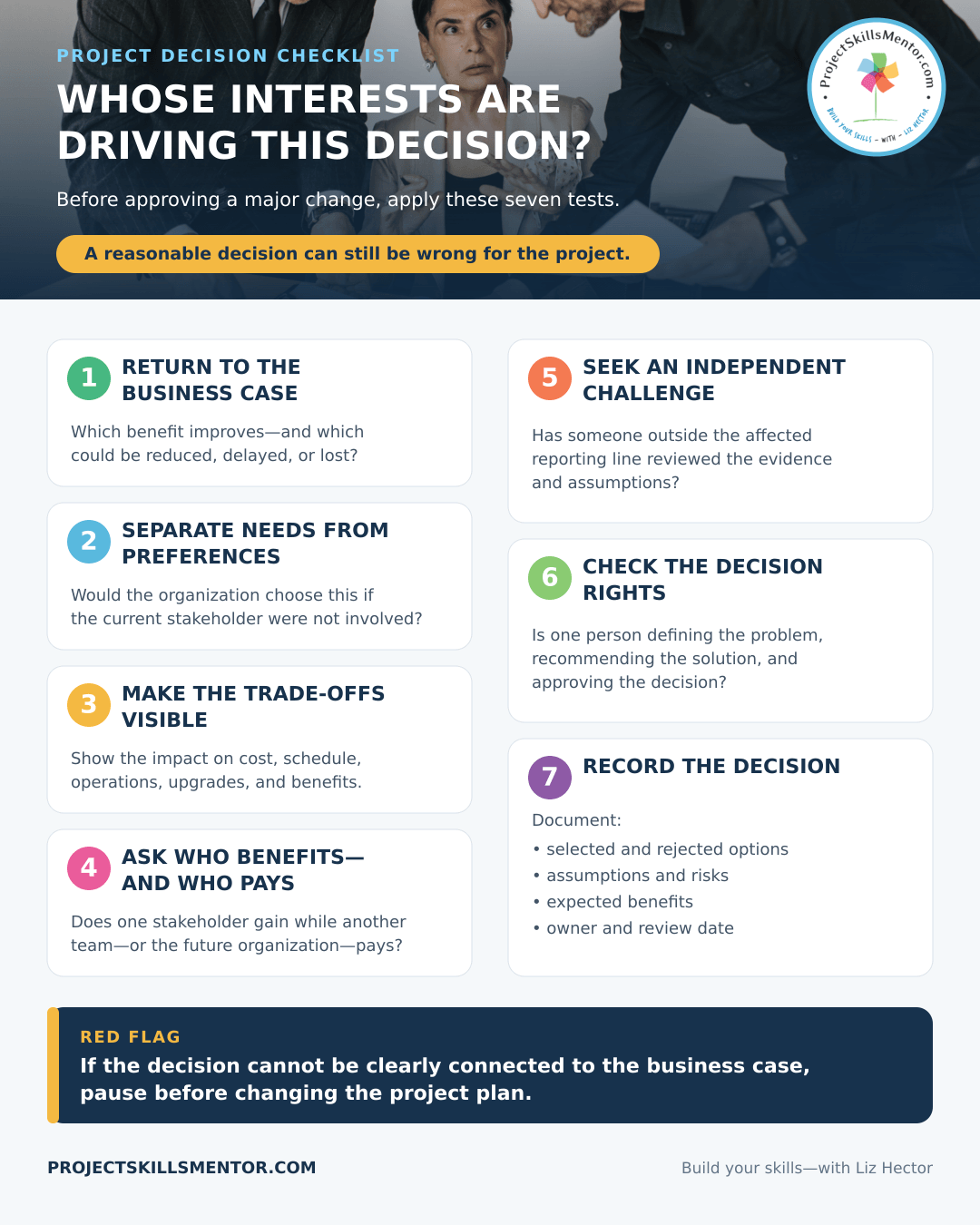
Seven tests for determining whose interests are driving a project decision.
Challenging a powerful stakeholder can be difficult, particularly when you suspect that personal incentives are influencing the decision. Accusing the stakeholder of self-interest usually creates defensiveness and makes objective discussion harder.
Instead, move the conversation from motive to impact. Useful questions include:
What changed in the business case after the contract was approved?
Which measurable outcome improves if we adopt this approach?
What additional customization and long-term support will it require?
Who owns the benefits after implementation and after the current leadership changes?
What evidence would cause us to reconsider this decision?
Can we document the decision, assumptions, risks, and accountable owner?
These questions do not attack the stakeholder. They make the organization confront whether the recommendation creates enterprise value or merely local comfort.
Build Governance Around Outcomes
A steering committee is not effective because senior people attend a monthly meeting. It is effective when the right people make timely decisions, resolve escalated issues, protect the business case, and remain accountable for benefits.
Before the project begins, define what success means and connect sponsor and steering committee responsibilities to those outcomes. Require declarations of material conflicts or competing incentives. Establish independent assurance for high-value decisions. Review the business case when the solution changes, not only when the budget changes. Finally, continue benefit ownership beyond go-live so that decision-makers cannot declare success simply because the system launched.
If stakeholders are measured on objectives that conflict with project success, make the conflict explicit and resolve it at the appropriate executive level. Project managers cannot repair a compensation system, but they can make its consequences visible.
The Project Manager’s Role in Protecting Business Value
Project managers are often told to manage scope, schedule, cost, risk, and stakeholders. But our deeper responsibility is to protect the connection between the project and the value it was created to deliver.
That requires more than tracking actions and producing status reports. It requires the courage to ask why a decision is being made, who benefits, what the organization will inherit, and whether the decision would survive independent scrutiny.
Not every stakeholder who resists change is acting selfishly. They may understand a genuine operational risk that the project team has missed. Good governance creates room for that evidence too. The goal is not to eliminate disagreement. The goal is to prevent power, politics, personal legacy, or hidden incentives from replacing evidence and enterprise value.
The next time an important project decision does not seem consistent with the business case, pause before updating the plan. Ask the question that may reveal the real project risk:
“Whose interests are driving this decision, and are they aligned with the interests of the project and the organization?”
And if you want to know more about putting good governance in place for your project, read this article next.