


You had a busy week. What did it move forward?
You answered 40 emails, sat through four meetings, and updated three spreadsheets. Then your mentor asks, “How’s that goal we talked about last month?”
You know exactly which goal they mean. You also know you haven’t touched it.
Here’s a question I use to tell whether I’ve made progress: What can I do now that I couldn’t do before?
Maybe you can finally start work because someone made a decision. Maybe you can lead a client meeting on your own because you’ve had a chance to practice and get feedback. If all you can point to is a full calendar, it’s worth looking at what filled it.
How I ended up doing two and a half jobs
“It’s important to have deeply held beliefs about the vision. But then you have to look at the results.” - Ginni Rometty
During my years at IBM, I ran projects, led business lines, and managed client relationships. At one point, I led the Human Capital Management team and kicked off new strategy work with a major customer. Then I was asked to get IBM Netherlands’ diversity efforts back on track.
I was already busy. I was also a people pleaser. I said yes. My vision was to show that I can do it all. But what were the results?
Before long, I felt like I was doing two and a half jobs. I was sleeping two to four hours a night. More than once, I looked at my calendar and found I was booked on two calls at the same time. I was proud of what my teams were doing, and we were getting a lot done. I was also beyond tired. It showed in my work and took a toll on my health that I still feel today.
I’d said yes to each assignment. What I hadn’t done was stop and ask where all those yeses were taking me. I was spending most of my time delivering on priorities other people had set, and I’d given very little thought to whether the work was taking me where I wanted to go.
The company had its goals. I wish I’d been clearer about mine. Looking back, the price was too high for what I was getting from the work.
These days, before I say yes to something big, I ask myself two questions.
What will have to come off my calendar to make room for this?
Is this work taking me in a direction I want to go?
When I looked at how my performance was assessed, I saw two expectations. I was expected to cover everything I’d taken on, and hitting my sales targets carried the most weight. Customer satisfaction and diversity and inclusion mattered to me. They counted for less in my performance assessment.
So what was the busywork? It was the time I spent trying to stay on top of all three responsibilities at once. How many calls actually needed me? How much time did I spend keeping up with updates when someone else could handle the next step? And how much attention did I have left for the work where I could make the biggest difference?
I had to step back and decide where to focus. My advice now is to find out what your company will judge you on and put that alongside what matters to you. If you want to build a career around developing people, for example, and sales drive your performance review, you need to decide how much room you can give both. That’s a conversation worth having before you say yes to either big responsibility.
Look at what your week made possible
“You can have anything, you can’t have everything.” - Jimmy Carr
In project management, a team can close 50 tickets in a sprint and still be waiting for the one decision that lets them release the product. If that decision is holding up the release, getting it made might be the most valuable thing you do all week.
The same applies to your career. If your goal is to lead client meetings, another hour polishing the status deck may be less useful than asking your manager to let you lead the risk discussion on Tuesday. Once you’ve done it, ask someone who was there what you did well and what you could do differently. Now you have something to work with.
It’s easy to lose sight of what matters when you start a new role. You may feel you should attend every meeting. Ask your manager which decisions they need your help with this month, then prioritize the meetings where you can contribute. If you’re invited mainly to stay informed, ask for the meeting notes so you can keep up without attending.
This logic applies to more than meetings. In my former job, I traveled a lot. I found that even short-term moves can overwhelm your ability to stay on track. If you keep sorting the same stack of papers, make one folder for the lease, contracts, and records you’ll need, so you can find them when it’s time to act. Here are my tips for organizing paperwork when moving.
Check your calendar before you try to work faster
“There is surely nothing quite so useless as doing with great efficiency what should not be done at all.” - Peter F. Drucker
If you work nine hours a day, look back at a typical day. How much of that time went toward the results you’re responsible for and the goals you’ve chosen for yourself? Some routine work has to happen. Look for the hours you can actually reclaim.
Pick one task you can shorten, combine, or hand off this week. Put the time you reclaim toward the goal you brought to your mentor.
Then put some of that time back into your calendar for a specific piece of work. If you need to prepare for a client decision, block time to do it without bouncing between email, chat, and the deck. Every switch asks you to pick up the thread again, which takes time even when each interruption feels brief.
Bring one goal and your calendar to your mentor
Before your next mentoring session, pick one goal and spend ten minutes answering the four questions below. Think back over the past week and write down what actually happened. Use the sample answers as a guide and draw on your own experience. You’ll bring concrete examples that you and your mentor can use to discuss.
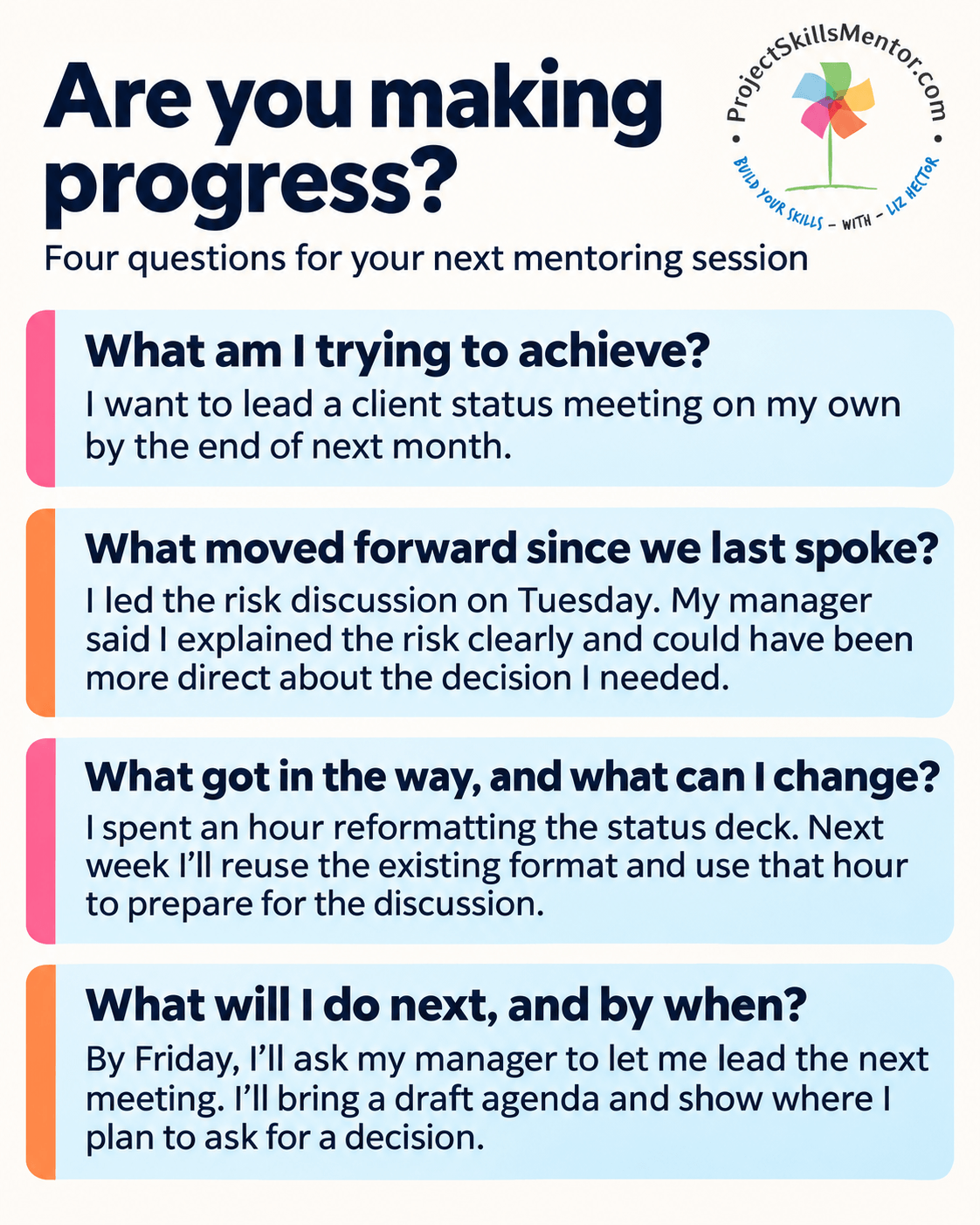
ProjectSkillsMentor card “Are you making progress?” Asks four questions for your next mentoring session: What am I trying to achieve? What has moved forward since we last spoke? What got in the way, and what can I change? What will I do next, and by when? Example answers show how to frame your answers in the context of your work against goals.
At your next session, start with what happened. If you still haven’t asked to lead the meeting, what stopped you? Maybe the timing was wrong. Maybe you’re unsure how to handle a difficult agenda item. Your mentor can help you figure out what to do about the actual obstacle.
Before you open your inbox tomorrow, check your calendar. What can you take out this week, and what will you do with the time you get back?
More on goals and mentoring
Turn a goal you care about into something you can act on and track. The Importance of Goals and How to Achieve Them
Set up mentoring conversations with clear goals and a way to review progress. The Mentoring Process
Revisit your goals when your mentoring conversations keep covering the same ground. When Mentoring Fails: How to Reboot for Success